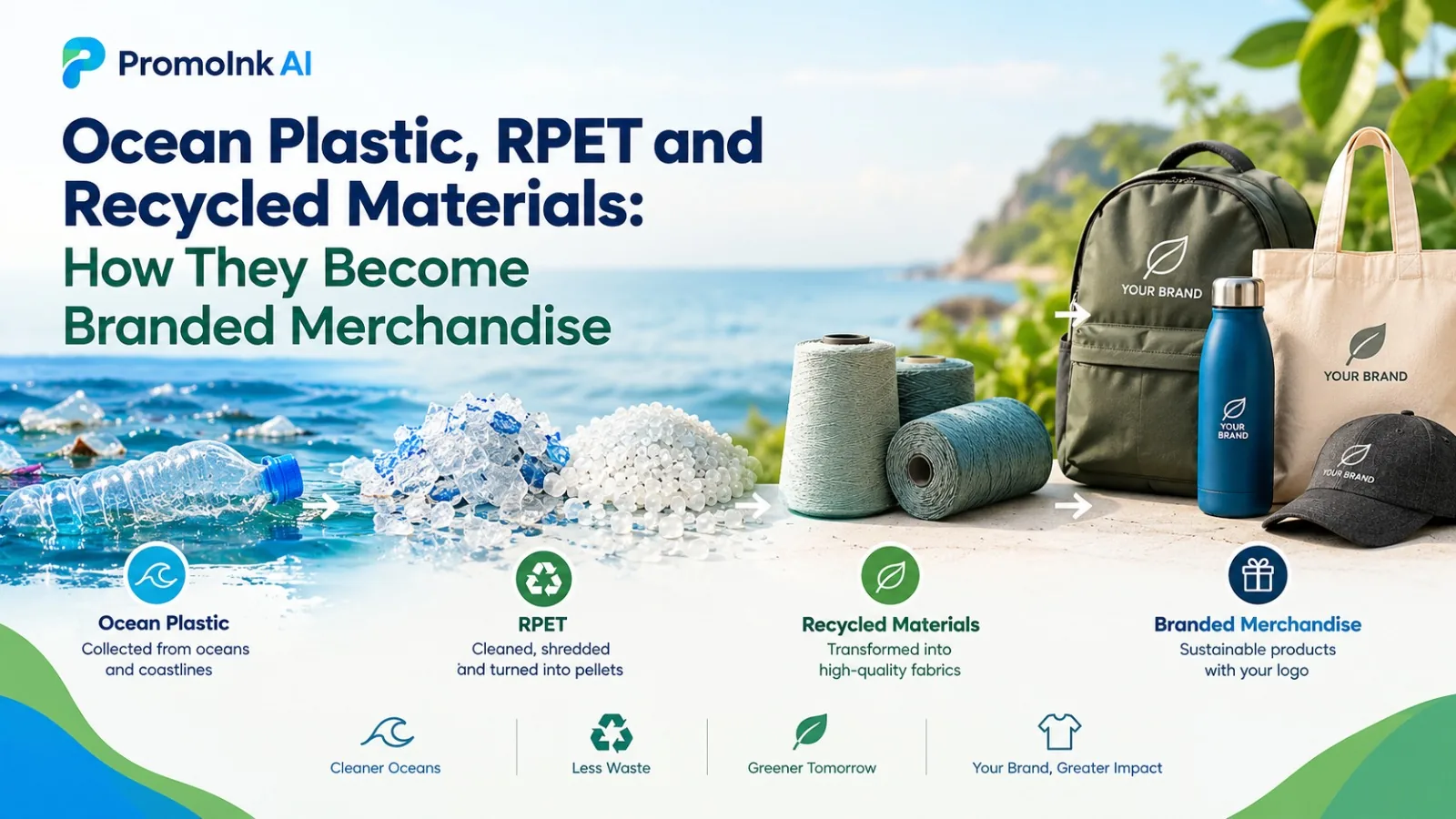
Plastic bottles and other PET waste can become useful branded merchandise through a multi-stage recycling and manufacturing process. Collection, sorting, cleaning, shredding, melting, pelletizing, spinning, molding, and product decoration can turn recovered plastic into materials used for bags, apparel, drinkware, and other promotional products. For brands evaluating sustainable merchandise, understanding how recycled plastic becomes promotional products makes it easier to ask suppliers the right questions and communicate material claims accurately. PromoInk AI helps businesses compare recycled branded merchandise and ask suppliers the right questions about material claims.
rPET and ocean plastic are not the same thing. rPET identifies recycled polyethylene terephthalate, while terms such as ocean plastic, ocean-recovered plastic, or coastal plastic describe where recovered material is sourced. Ocean-related plastic can include different resin types, so only recovered PET that is appropriately processed becomes rPET.
What Is rPET Made From?
rPET stands for recycled polyethylene terephthalate. PET is a common plastic used in beverage bottles, food containers, and other packaging. After suitable PET items are collected and processed, the recovered plastic can be converted into recycled PET, commonly called rPET.
The feedstock can come from post-consumer materials, such as used beverage bottles, or from manufacturing waste that is recovered before reaching consumers. Under FTC guidance, a recycled-content claim should refer to material that has been recovered or otherwise diverted from the waste stream, either during manufacturing or after consumer use.
rPET is not a different type of plastic. It is PET that has gone through a recovery and reprocessing cycle.
Because rPET retains PET as its underlying polymer, it can be processed into fibers, sheets, resins, and other forms used in new products. However, finished-product performance depends on the recycled feedstock, manufacturing process, material blend, construction, and intended application.
The Journey From Discarded Plastic to Usable Material
The exact recycling pathway varies by facility and end use. A common mechanical recycling pathway for recovered PET includes collection, sorting, cleaning, size reduction into flakes, further processing, and conversion into material suitable for manufacturing.
1. Plastic Is Collected
The process begins with PET items entering a collection system. Beverage bottles are a common source because they are widely used and can be separated from other materials.
Terms such as ocean-recovered plastic, coastal plastic, and ocean-bound plastic can describe different sourcing scenarios and should not automatically be treated as interchangeable. Material physically recovered from a marine environment is different from plastic collected on land because it was considered at risk of entering the ocean. Buyers should therefore ask suppliers exactly what sourcing definition supports the claim.
2. Materials Are Sorted
Collected plastic is separated according to resin type, color, condition, and other characteristics.
Sorting matters because different plastics behave differently during processing. PET bottles must be separated from materials that are unsuitable for the intended recycling stream. Contamination, labels, caps, adhesives, and non-PET materials may also need to be removed or managed.
The cleaner and more consistent the feedstock, the easier it is to produce material with predictable characteristics.
3. Bottles and Plastic Are Cleaned
After sorting, the material is washed and prepared for further processing.
This stage removes dirt, residues, labels, adhesives, and other contaminants. The exact cleaning process depends on the feedstock and the requirements of the recycling facility.
The material may then be dried before being processed into smaller pieces.
4. Plastic Is Shredded Into Flakes
Clean PET is mechanically shredded into small flakes.
These flakes are easier to handle, inspect, separate, and process than whole bottles. Additional sorting may occur at this stage to improve material consistency.
For manufacturers, consistent recycled feedstock is important because the next stages depend on predictable material properties.
5. Flakes Are Prepared for Manufacturing
Clean PET flakes may be melted, filtered, pelletized, or otherwise prepared for the next manufacturing stage, depending on the facility and intended product.
In some supply chains, recycled PET is converted into pellets before being used again. In others, processed flakes may move into downstream manufacturing without a separate pelletizing stage.
The important point for buyers is that a discarded PET bottle does not become a finished promotional product in a single step. It passes through several recovery, purification, and manufacturing stages before becoming usable material again.
How rPET Becomes Promotional Merchandise
Once recycled PET has been processed into usable material, manufacturers can convert it into different forms depending on the product.
For textiles, recycled PET can be processed into fibers. Those fibers can then be spun into yarn and incorporated into fabrics used for bags, apparel, pouches, lanyards, and other textile products.
For molded products, recycled material can be processed into forms suitable for manufacturing items such as certain containers and accessories.
A simplified supply chain looks like this:
Collected PET → Sorting → Cleaning → Flakes → Reprocessing → Recycled resin, fiber, yarn, sheet, or other usable material → Product manufacturing → Decoration → Finished merchandise
The final promotional product is therefore the result of several manufacturing stages, not a direct conversion from a bottle into a finished item.
Where Recycled Ocean Plastic Fits Into the Process
Recycled ocean plastic merchandise requires more attention to sourcing because the material's origin is part of the product story.
Plastic recovered from coastal or marine-adjacent environments may require collection, transportation, sorting, cleaning, and additional processing before it can enter a manufacturing stream.
Some programs focus on plastic collected from areas near waterways before it reaches the ocean. This sourcing approach is different from recovering plastic directly from a marine environment, so buyers should request a clear explanation of the supplier's terminology and collection methods.
For a marketing team, the useful questions are specific:
- Where was the material collected?
- What type of plastic was recovered?
- Was the material post-consumer?
- How was it processed?
- What percentage of the finished product contains recycled material?
- Is the claim verified by documentation or certification?
- Does the claim apply to the entire product or only a component?
- What definition is being used for “ocean,” “ocean-bound,” or “coastal” plastic?
These questions help separate a documented material story from a vague sustainability statement.
Are Recycled Promotional Products Good Quality?
Recycled promotional products can perform well, but recycled content alone does not determine product quality. Performance depends on the polymer, recycled-content percentage, processing quality, material blend, construction, decoration method, and intended use.
Recycled content does not automatically determine how durable or functional an item will be. A well-made rPET bag can be durable, while a poorly constructed recycled product may perform poorly. The same principle applies to conventional materials.
For buyers evaluating quality, review the following factors:
When evaluating product quality, check the material, including the polymer type, recycled-content percentage, and whether it is blended with virgin or other fibers or materials. For construction, inspect stitching, seams, closures, handles, and joins to assess durability.
For fabric, consider weight, weave, finish, and fiber composition. For decoration, review the printing or embroidery method and its expected durability. Assess product use by considering how frequently the item will be used, the environment in which it will be used, and the load it must support.
Check documentation for material claims, certifications, and supplier records to verify product specifications. Finally, review care requirements, including cleaning instructions and any product limitations that could affect its lifespan.
The recycled label should be considered one specification among several, not a substitute for checking construction and performance.
Recycled Material Does Not Mean Recycled Forever
Plastic recycling can extend the useful life of a material, but it does not automatically mean the finished promotional product will be recycled again.
A product may contain multiple materials, coatings, adhesives, trims, dyes, or decoration components that make end-of-life processing more difficult. Recycling infrastructure also varies by location and product type.
For marketing teams, this distinction matters. A product can contain recycled content without being readily recyclable through local recycling programs.
The FTC advises marketers to qualify environmental claims when necessary and avoid broad, unsupported claims such as unqualified “eco-friendly” statements. Recycled-content claims should clearly communicate the relevant material information rather than implying environmental benefits beyond what can be supported.
How to Evaluate an rPET Supplier
A reliable sourcing conversation should go beyond asking, “Is this recycled?”
Use a simple documentation checklist:
Ask about the feedstock
Find out if the material is post-consumer, pre-consumer, or another recovered source.
Request the recycled-content percentage
A product described as recycled may contain only a portion of recycled material.
Clarify the sourcing story
For ocean or coastal plastic claims, ask where and how the material was recovered.
Check certification scope, not just the logo
Standards such as the Recycled Claim Standard (RCS) and Global Recycled Standard (GRS) can be used to verify and track recycled material through the supply chain. Textile Exchange describes both as third-party systems for recycled-material verification and chain of custody; GRS also includes additional processing, social, environmental, and chemical requirements. Ask if the certification applies to the supplier, material, transaction, or finished product being purchased rather than assuming that a certification logo applies to every item the supplier sells.
Review the finished product specifications
Confirm fabric weight, construction, capacity, dimensions, or other performance details.
Request decoration specifications
The recycled material and the decoration method both contribute to the finished product.
Ask for samples
A physical sample allows teams to assess texture, construction, print quality, and usability before placing a larger order.
This process also gives marketing teams credible information for campaign copy, product descriptions, packaging, and internal sustainability communications.
What Documentation Should Support an rPET Claim?
Depending on the product and supplier, useful documentation may include:
- Recycled-content percentage
- Polymer or fiber composition
- Identification of post-consumer versus pre-consumer recycled input
- Supplier material specification
- Relevant scope or transaction certificates
- Chain-of-custody documentation where applicable
- Written support for ocean, coastal, or ocean-bound sourcing claims
- Confirmation of which part of the finished product contains the recycled material
Documentation should match the claim being made. For example, evidence that a fabric contains recycled PET does not automatically prove that the entire finished bag is made from recycled material if the zipper, lining, handles, coating, or other components use different materials.
rPET Compared With Conventional PET
Conventional PET is primarily made from newly produced PET resin derived from petrochemical feedstock, which is manufactured into products such as drinkware, packaging, textiles, and accessories. Virgin PET itself contains no recycled content, although a finished product may combine virgin and recycled PET. Its quality depends on product design and manufacturing, while its end-of-life options depend on the product and local recycling infrastructure.
Recycled PET (rPET), by contrast, is made from recovered and reprocessed PET, commonly sourced from used PET products or manufacturing waste. Existing PET is collected and reprocessed into materials for products such as bags, textiles, apparel, accessories, and other promotional items. Depending on the product specification, rPET can represent part or all of a product's PET content. Its quality depends on the feedstock, processing, and manufacturing methods, while its end-of-life options depend on the product's composition and local recycling infrastructure.
The comparison shows why material selection should be considered alongside product construction, intended use, and sourcing documentation.
How Brands Can Tell the Recycling Story Accurately
A strong sustainability message does not need exaggerated language. It needs useful details.
Instead of simply describing a product as “green,” a brand can explain the material source and the part of the product made with recycled content. The FTC advises that recycled-content claims should be qualified when a product contains only a portion of recycled material.
For example, a product description could explain that a bag contains a stated percentage of recycled PET fabric, provided that figure is supported by the supplier's documentation.
That kind of wording gives customers something concrete to understand and gives marketing teams a stronger foundation for responsible messaging.
For additional guidance on evaluating environmental claims and product materials, read our article
Why Supply-Chain Details Matter for Branded Merchandise
Promotional products often carry a brand message long after an event or campaign ends. The material story becomes part of that message.
A recycled product can support sustainability-focused campaigns, employee programs, conferences, customer gifts, and corporate merchandise. But the strongest product stories are built around verifiable details:
- Material source
- Recycled-content percentage
- Manufacturing process
- Certification or documentation
- Product construction
- Intended use
- End-of-life information
The more precise the information, the easier it is for marketing teams to describe the product accurately and avoid unsupported environmental claims.
Frequently Asked Questions
What Is rPET Made From?
rPET is made from recovered PET plastic that has been collected, sorted, cleaned, processed, and converted into recycled material. Used PET beverage bottles are one common source.
How Does Recycled Plastic Become Promotional Products?
Recycled plastic is collected, sorted, cleaned, and shredded into flakes, then prepared as recycled resin, fiber, yarn, sheet, or another manufacturing input. Manufacturers use those materials to create finished promotional products that can later be decorated with a brand logo or design.
Are Recycled Promotional Products Good Quality?
They can be. Product quality depends on the recycled material, manufacturing process, construction, decoration method, and intended use. Recycled content alone does not determine durability.
Is rPET the Same as Recycled Plastic?
rPET is a specific type of recycled plastic made from PET. “Recycled plastic” is a broader term that can refer to several plastic types.
Is Ocean Plastic the Same as rPET?
No. rPET describes a material: recycled polyethylene terephthalate. “Ocean plastic” describes a sourcing claim related to where plastic was recovered or intercepted. Ocean-related plastic may include polymers other than PET, so it only becomes rPET when the recovered material is PET and is processed into recycled PET.
How Can Businesses Verify Recycled-Content Claims?
Ask suppliers for the recycled-content percentage, material source, relevant certifications or documentation, and information showing how the claim applies to the finished product. Clear documentation makes environmental marketing claims easier to communicate accurately.
Does rPET Mean the Entire Product Is Recycled?
Not necessarily. rPET may apply to one material or component of a finished product. For example, the main fabric of a bag may contain recycled PET while zippers, coatings, straps, labels, or other components use different materials. Check the supplier's composition and recycled-content documentation before describing the entire product as recycled.
Turn Recycled Material Into a Verifiable Brand Story
The journey from recovered PET to branded merchandise involves more than collecting bottles and adding a logo. Material must be identified, sorted, cleaned, reprocessed, manufactured into a new product, and then decorated.
For buyers, the most important questions are what material was recovered, what percentage of the finished product contains recycled content, which components the claim covers, and what documentation supports it.
PromoInk AI can help businesses compare rPET and other recycled promotional products based on material composition, product specifications, decoration requirements, and available sourcing documentation. Share your product type, quantity, branding needs, and sustainability requirements to narrow the available options.