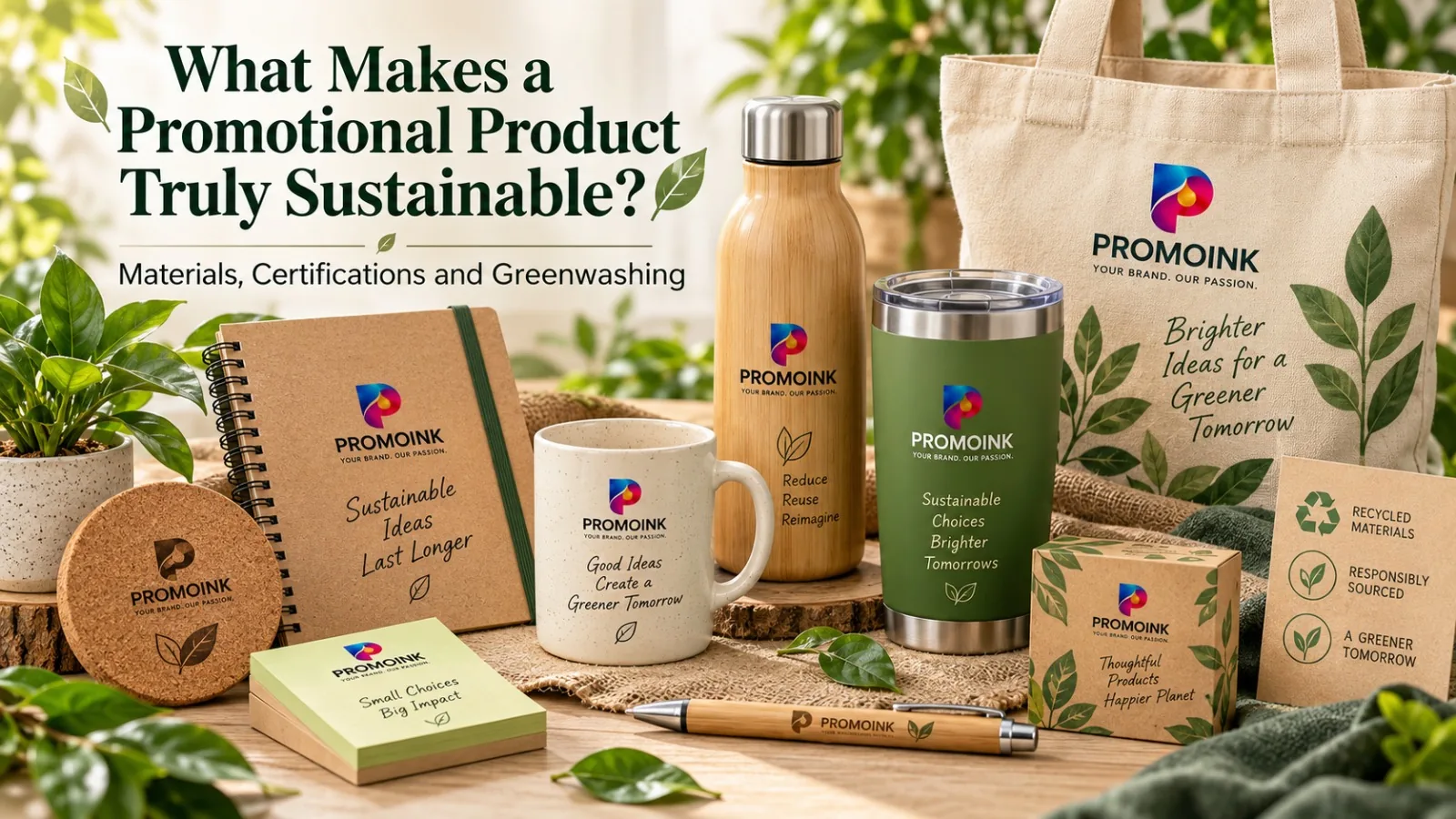
Sustainable promotional products combine responsible materials, credible certifications, durable design, useful functionality, and transparent environmental claims. What makes promotional products sustainable is not a single material or logo on the packaging. Buyers need to look at the product, its supply chain, supporting documentation, expected use, and end-of-life options as a complete picture. For procurement teams, this means replacing vague "eco" claims with verifiable details. Promo Ink AI supports branded merchandise purchasing with product review and quality checks that can help buyers make more informed decisions.
Sustainability Starts With More Than the Material
Material selection is an important starting point, but it does not tell the entire sustainability story.
A promotional tote made from recycled polyester may contain recycled material, but buyers still need to know the percentage, source, certification, manufacturing requirements, packaging, and expected lifespan. An organic cotton shirt can carry meaningful credentials, yet its overall footprint also involves dyeing, finishing, transportation, decoration, use, and disposal.
A useful eco friendly promo material guide should therefore consider several attributes together:
- Material origin: Identify the actual fiber, plastic, metal, paper, or other material used.
- Recycled or renewable content: Ask for the percentage rather than relying on broad wording.
- Certification: Check if an independent standard verifies the relevant claim.
- Durability: Products that remain useful for a longer period can reduce the need for frequent replacement.
- Product usefulness: A reusable item only creates practical value if recipients actually use it.
- Packaging: Review unnecessary plastic, inserts, and secondary packaging.
- End of life: Consider recycling, reuse, repair, or responsible disposal options.
The goal is not to label one material as universally better. Different products have different environmental considerations. A procurement team needs enough information to understand those tradeoffs before placing an order.
What GOTS and GRS Actually Tell Buyers
Certification can make sustainability claims more meaningful because recognized standards establish defined requirements and verification procedures.
GOTS: Organic Textile Certification
The Global Organic Textile Standard, commonly called GOTS, covers textiles made from at least 70% certified organic natural fibers. GOTS Version 8.0 covers processing, manufacturing, packaging, labeling, trading, and distribution, while also addressing environmental, social, chemical management, traceability, and governance criteria.
GOTS also uses third-party certification and auditing. The standard's scope can include products such as fibers, yarns, fabrics, garments, textile accessories, and home textiles.
For a promotional apparel buyer, this means "organic cotton" and "GOTS certified" are not interchangeable statements. Organic fiber describes the material. GOTS certification indicates that the applicable textile supply chain meets the standard's defined requirements.
GRS: Recycled Material Verification
The Global Recycled Standard, or GRS, focuses on recycled materials and chain of custody. Textile Exchange states that GRS includes a 50% minimum recycled content threshold for consumer-facing labeling, along with additional social, environmental, and chemical requirements.
GRS also uses third-party certification to verify certified material through stages of the supply chain. Its requirements cover recycled inputs, responsible production, chain of custody, and restricted chemical use.
Textile Exchange released GRS Version 5.0 in July 2026, so procurement teams working with current merchandise programs should ask suppliers which standard version and certification documentation apply to their products.
GOTS and GRS Certifications Explained
Certification
- GOTS
- GRS
- RCS
- No certification
Primary focus
- Certified organic natural-fiber textiles
- Recycled materials and responsible processing
- Recycled content and chain of custody
- Supplier-specific environmental claim
What buyers should verify
- Organic fiber content, certification scope, processing requirements, traceability
- Recycled content, chain of custody, certification scope, processing requirements
- Recycled material percentage and supply-chain verification
- Material composition, evidence, testing, supplier documentation
Certification does not mean a product has zero environmental impact. It means the product or supply chain has been assessed against the requirements of a particular standard. That distinction should remain clear in procurement records and marketing copy.
A Certified Material Does Not Tell the Whole Story
A product can have credible certification and still require additional evaluation.
Imagine a promotional bag made with certified recycled fibers. The certification may provide evidence about recycled content and supply-chain controls, but procurement teams can still ask:
- How durable is the bag?
- How often will recipients use it?
- How is it packaged?
- How far does it travel before delivery?
- Does the decoration process introduce additional materials?
- What happens when the bag is no longer usable?
The same principle applies to reusable bottles, tumblers, apparel, notebooks, and other merchandise.
A sustainability claim should describe a specific attribute rather than imply that every aspect of a product is environmentally preferable.
How to Avoid Greenwashing in Swag
Learning how to avoid greenwashing in swag starts with treating broad environmental language carefully.
Terms such as "eco-friendly," "green," and "sustainable" can create a broad impression without telling buyers what has actually been improved. The U.S. Federal Trade Commission's Green Guides advise marketers against broad, unqualified environmental benefit claims because they can imply environmental advantages that are difficult to substantiate.
For procurement teams, vague wording should trigger a request for evidence rather than an immediate rejection.
Look for specific information such as:
- Recycled content percentage
- Organic fiber percentage
- Applicable certification
- Certification body
- Certificate or license information
- Chain-of-custody documentation
- Product composition
- Manufacturing requirements
- Packaging details
- Recycling or disposal conditions
For example, "made with recycled materials" gives limited information. A statement specifying that a product contains a defined percentage of recycled material and identifying the applicable certification gives buyers something concrete to verify.
The FTC also advises that recycled-content claims should identify the amount of recycled material when a product is only partly made from recycled content.
Be Careful With Recyclable and Biodegradable Claims
Environmental claims can become misleading when the disposal conditions are left out.
A product described as recyclable may require access to a particular recycling system that is not available everywhere. Similarly, biodegradable materials may require specific environmental conditions to break down. The FTC's guidance states that recyclable and biodegradable claims should be appropriately qualified when access or disposal conditions limit the environmental benefit consumers may reasonably expect.
Procurement teams should therefore ask:
- Is the entire product recyclable or only part of it?
- Are local recycling facilities equipped to process it?
- Does the product require commercial composting?
- Are special disposal conditions required?
- Does the claim apply to the product, packaging, or both?
These details are especially useful for sustainability reports and customer-facing campaigns because they prevent a narrow product attribute from being presented as a broad environmental promise.
Product Lifespan Matters
A promotional product has little practical sustainability value if it is discarded soon after an event.
Durability should be considered alongside material choice. A reusable bottle that remains functional for years has a different use profile from a low-durability item that is quickly replaced.
Buyers can assess:
- Construction quality
- Material thickness
- Closure or fastening quality
- Washability
- Resistance to regular use
- Care requirements
- Warranty information, when available
- Expected frequency of use
For apparel, specifications such as fabric composition and weight can also help buyers judge expected performance. For instance, fabric weight, fiber type, and construction provide useful context when selecting promotional shirts for repeated wear.
The objective is simple: choose merchandise that has a realistic reason to remain in use.
A Procurement Checklist for Sustainable Merchandise
This checklist can make supplier comparisons more consistent.
1. Define the environmental claim
Decide what the purchase is meant to address, such as recycled content, organic fibers, reduced packaging, or long-term reuse.
2. Request product specifications
Ask for the complete material composition rather than accepting a general product description.
3. Verify certification
Confirm the certification name, certificate status, applicable product category, and certification scope.
4. Review the evidence
Keep supporting documentation with the purchase record. This is particularly useful when sustainability claims will appear in customer communications.
5. Assess product usefulness
Consider the audience, event, workplace, or campaign and estimate how likely recipients are to use the item.
6. Review packaging and shipping
Look beyond the product itself. Packaging and logistics are part of the purchasing decision.
7. Check end-of-life information
Ask suppliers how the item and its packaging should be reused, recycled, or disposed of.
PromoInk AI can be part of a procurement workflow that considers product specifications and order quality alongside branding requirements, helping teams review merchandise before it reaches recipients.
Common Claims and the Questions Behind Them
Marketing claim
- Eco-friendly
- Made from recycled material
- Organic cotton
- Recyclable
- Biodegradable
- Sustainable
- Reusable
Better question to ask
- What specific environmental attribute does this claim describe?
- What percentage is recycled, and is it certified?
- Is the fiber certified organic, and is the finished textile covered by a relevant standard?
- Can the product actually be recycled through commonly available facilities?
- Under what conditions does it biodegrade, and how long does the process take?
- Which measurable environmental or social attributes support the claim?
- What makes the item suitable for repeated use?
This approach also helps marketing teams write more precise product descriptions. Specific claims are easier for customers to understand and easier for procurement teams to document.
Why Certification Literacy Builds Better Buying Decisions
Certification literacy gives procurement professionals a practical way to distinguish a defined standard from an unsupported marketing statement.
GOTS and GRS serve different purposes. GOTS focuses on certified organic natural-fiber textiles and supply-chain requirements, while GRS addresses recycled material, chain of custody, and additional processing requirements.
Neither standard should be treated as a universal environmental score. The correct certification depends on the product and the claim being evaluated.
The current standards also change over time. GOTS Version 8.0 was released in March 2026, with mandatory adherence beginning March 1, 2027. GRS Version 5.0 was released in July 2026. Keeping supplier documentation current is therefore part of responsible procurement.
Frequently Asked Questions
What makes a promotional product sustainable?
A promotional product can have stronger sustainability credentials when it uses responsibly sourced or certified materials, provides transparent documentation, is durable and useful, and has realistic options for reuse or responsible end of life. No single feature establishes sustainability across the entire lifecycle.
Is recycled material enough to make promotional products sustainable?
No. Recycled content is one attribute. Buyers should also consider the percentage of recycled material, certification, manufacturing, durability, packaging, transportation, intended use, and end-of-life options.
What is the difference between GOTS and GRS?
GOTS applies to textiles made with certified organic natural fibers and includes requirements covering processing, manufacturing, environmental criteria, social criteria, and traceability. GRS focuses on recycled materials, chain of custody, and additional social, environmental, and chemical requirements.
How can procurement teams identify greenwashing?
Look for vague environmental claims without measurable supporting information. Ask for material percentages, certification documents, certification scope, chain-of-custody evidence, and specific disposal or recycling conditions.
Does a sustainability certification mean a product has no environmental impact?
No. A certification verifies compliance with a defined standard. It does not establish that a product has zero environmental impact.
Should every promotional product have a sustainability certification?
Not necessarily. Certification can provide useful independent verification, but other evidence can also help buyers assess a product. The appropriate documentation depends on the material, product category, supplier claim, and intended use.
Making Sustainable Merchandise Claims More Credible
Sustainable promotional sourcing works best when environmental language is supported by product-level evidence. Start with the actual material, identify the relevant certification, verify documentation, consider durability and usefulness, and examine what happens after the product reaches the recipient.
This process gives procurement teams a clearer basis for comparing merchandise and gives marketing teams stronger information for communicating environmental attributes accurately. It also leaves less room for broad claims that sound impressive but provide little evidence.
For organizations building a responsible merchandise program, get in touch with us to discuss product specifications, branding requirements, and order details. A thoughtful purchasing process can help your team choose promotional products that are useful, credible, and supported by information buyers can actually verify.