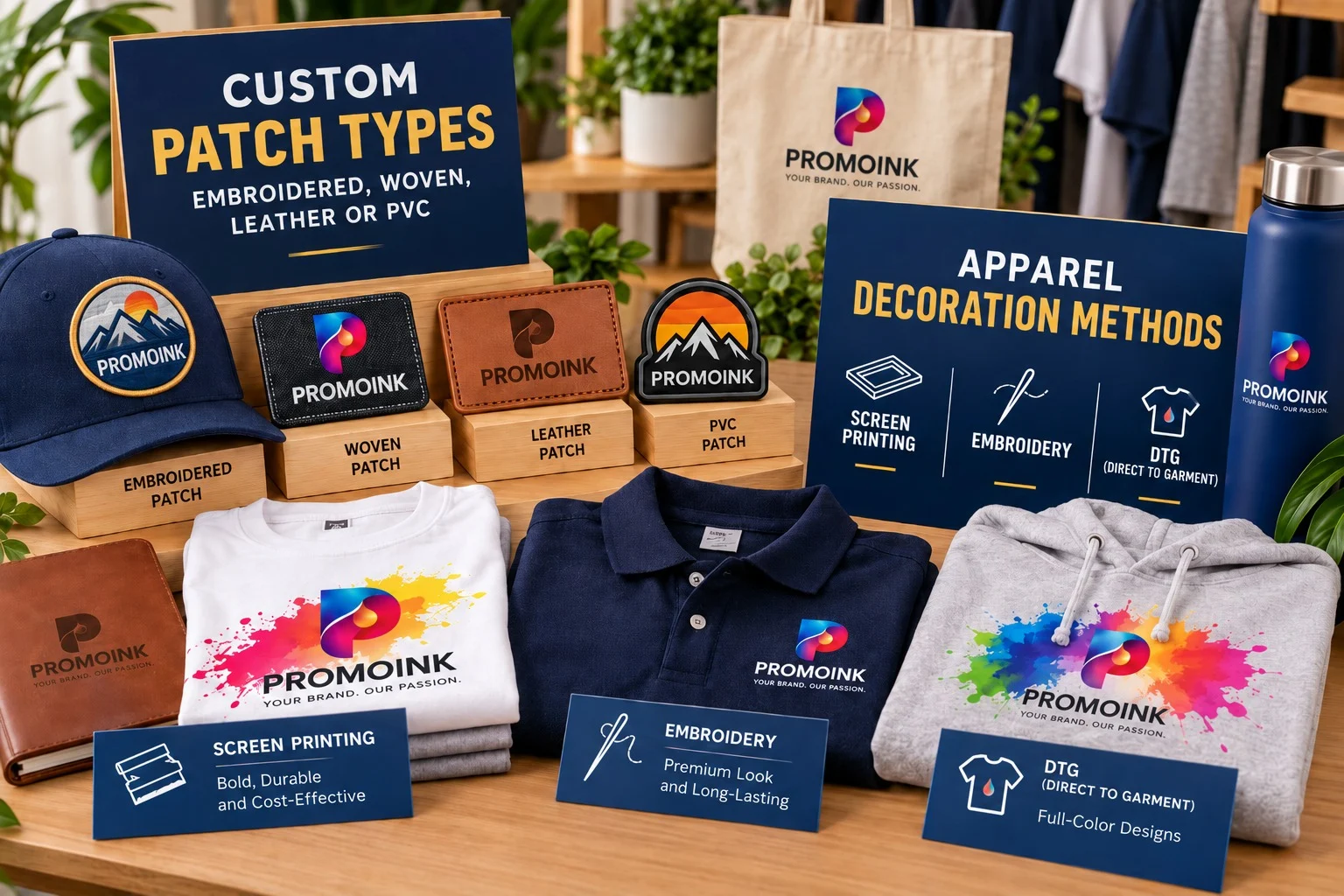
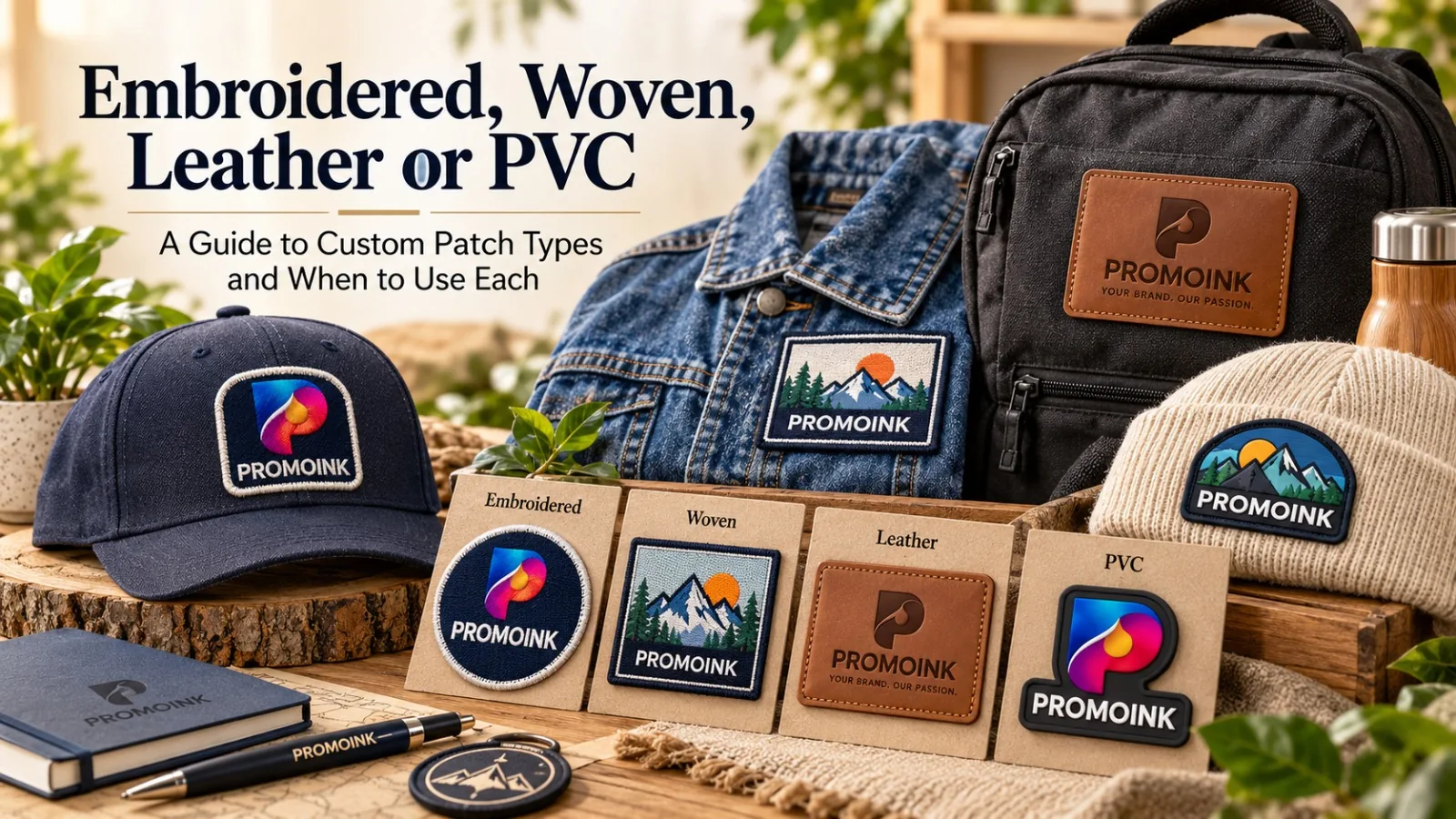
Attachment also matters: iron-on patches suit easy application, while sew-on patches provide a more permanent finish. PromoInk AI helps buyers match patch materials and attachment methods to apparel, uniforms, hats, bags, and other branded gear.
Embroidered Patches: A Traditional Textured Finish
Embroidered patches use stitched thread on a fabric backing. The raised thread creates a textured appearance that works particularly well for logos, names, emblems, and designs with bold lettering.
They are a strong choice for jackets, work shirts, uniforms, backpacks, caps, and team apparel. The stitched surface gives the patch a classic appearance that fits both professional and casual garments.
Choose embroidered patches for:
- Logos with bold shapes and readable lettering
- Uniforms that need a traditional appearance
- Hats and jackets
- Designs where visible thread texture adds character
- Applications that benefit from a substantial patch surface
One limitation is very fine artwork. Tiny lettering, narrow lines, and intricate details can become difficult to reproduce clearly because the design is built from thread.
Woven Patches: Better Detail for Smaller Designs
Woven patches use thin threads woven closely together instead of the thicker stitches found on traditional embroidered patches. The flatter construction allows smaller details and finer lettering to appear more clearly.
The difference becomes especially useful for logos containing compact text or detailed shapes.
Woven vs embroidered patches
Feature
- Surface
- Small lettering
- Fine lines
- Visual character
- Common uses
- Texture
Woven Patches
- Flat and smooth
- Generally clearer
- Better suited
- Clean and precise
- Detailed logos, apparel, caps
- Low
Embroidered Patches
- Raised and textured
- Can lose very small details
- Better for bold lines
- Classic and dimensional
- Uniforms, jackets, hats
- High
Woven patches can be a practical option for corporate logos, event branding, club insignias, and headwear designs where a clean appearance matters more than heavy texture.
Leather Patches: A Premium Material Statement
Leather patches bring a distinct material character that differs from textile-based patches. They can be made from genuine leather or synthetic leather alternatives, depending on the product requirements and budget.
Their natural or leather-like surface pairs particularly well with denim, canvas, hats, bags, workwear, and lifestyle apparel. Logos are commonly applied through techniques such as debossing, embossing, engraving, or printing.
Leather patches work especially well for brands that want their logo to feel integrated into the product rather than simply printed or stitched onto it.
Consider leather patches for:
- Denim jackets and jeans
- Canvas bags and accessories
- Structured caps and hats
- Outdoor-inspired apparel
- Brands that prefer a tactile material finish
Leather can require more care than PVC, and the final appearance can vary depending on the leather type and decoration method.
PVC Patches: Built for Tougher Conditions
PVC patches are made from a flexible synthetic material that is resistant to moisture and easy to clean. Their molded construction creates a distinct raised or recessed appearance.
They are commonly used on outdoor apparel, tactical-style gear, sports accessories, bags, uniforms, and headwear. PVC also allows designers to build layered shapes and dimensional elements into a patch.
Leather patch vs PVC patch
Feature
- Material feel
- Texture
- Moisture resistance
- Design style
- Cleaning
- Common uses
Leather Patch
- Natural or leather-like
- Smooth, grainy, embossed, or debossed
- Depends on material and finish
- Refined, rugged, classic
- Requires material-appropriate care
- Denim, canvas, hats, bags
PVC Patch
- Flexible synthetic
- Smooth, raised, or recessed
- High
- Bold, modern, dimensional
- Generally easy to wipe clean
- Outdoor gear, uniforms, sportswear
PVC is useful for products exposed to moisture, dirt, or frequent handling. Leather can be a better visual match for products where material character is central to the design.
Material Selection Should Start With the Garment
The same logo can look very different depending on the item receiving the patch. A patch that works beautifully on a structured cap may feel out of place on a lightweight performance shirt.
Start with the garment or accessory rather than the logo alone.
Embroidered and leather patches are common choices for structured headwear. Woven patches can work well for detailed logos, especially when small lettering needs to remain legible. PVC is useful for outdoor or sports-oriented caps.
Embroidered patches remain a practical choice for names, departments, company marks, and identification. Woven patches can help with detailed logos. PVC may suit uniforms used in wet or demanding environments.
Denim, canvas, and heavier jackets can support embroidered, leather, and PVC patches. The weight and texture of the garment should be considered before selecting the patch backing and attachment method.
Bags offer more flexibility because their materials can range from canvas and cotton to nylon and synthetic fabrics. Leather and PVC can create a strong visual contrast, while embroidered and woven patches work well for textile bags.
Iron-On vs Sew-On Patches: Attachment Matters
Patch material is only half of the decision. The attachment method determines how the patch is installed and how well it stays in place.
Iron-on patches
Iron-on patches have a heat-activated adhesive backing. Heat is applied to bond the patch to the garment.
They can be useful for:
- Quick application
- Retail or DIY projects
- Event merchandise
- Apparel where easy installation is preferred
Before using an iron-on patch, check the garment's fabric and care instructions. Some synthetic materials can be damaged by high heat, and some surfaces may not provide enough heat resistance for this method.
Sew-on patches
Sew-on patches are attached directly with thread. This method provides a mechanical attachment rather than relying only on adhesive.
They are often preferred for:
- Work uniforms
- Frequently washed garments
- Heavy jackets
- Bags and equipment
- Long-term applications
Sewing also gives buyers flexibility when applying patches to materials that are unsuitable for heat.
Iron-on vs sew-on patches at a glance
Consideration
- Installation
- Equipment
- Durability
- Heat-sensitive fabrics
- Long-term uniform use
- Removal
Iron-On
- Fast with heat
- Heat source
- Depends on adhesive and garment
- May not be suitable
- Depends on application
Sew-On
- Requires stitching
- Needle and thread or machine
- Strong mechanical attachment
- Generally more adaptable
- Often preferred
- More involved
Some patches can also use both adhesive and stitching. This can provide the convenience of positioning with additional mechanical reinforcement.
A Simple Patch Decision Matrix
A decision matrix makes material selection easier for buyers managing multiple apparel or headwear orders.
Your Priority
- Classic stitched appearance
- Fine logo details
- Leather-style branding
- Moisture resistance
- Frequent uniform washing
- Detailed cap logo
- Rugged outdoor gear
- Denim or canvas style
Recommended Patch Type
- Embroidered
- Woven
- Leather
- PVC
- Embroidered or woven
- Woven
- PVC
- Leather or embroidered
Attachment to Consider
- Sew-on or iron-on
- Sew-on or iron-on
- Sew-on
- Sew-on or compatible backing
- Sew-on
- Sew-on or iron-on
- Sew-on
- Sew-on
The table provides a starting point rather than a universal rule. Fabric weight, patch size, logo detail, washing conditions, and intended use should all be reviewed before production.
Artwork Can Change the Best Material Choice
Your logo itself should influence the patch decision. A design with three bold colors and large lettering gives you more flexibility than one containing tiny text, narrow lines, gradients, and complex illustrations.
Before production, review:
- Smallest lettering size
- Number of colors
- Fine lines
- Logo shape
- Desired patch dimensions
- Border requirements
- Surface texture
- Garment color
A simplified version of a detailed logo may reproduce better on a patch than using the full artwork without adjustment. For headwear, also consider the available decoration area. A large design may work on the front of a jacket but require a smaller, simplified version for a cap.
Think About Care and Wear Before Ordering
The environment in which the apparel will be used should influence the material and attachment method.
For garments exposed to regular washing, repeated handling, or outdoor conditions, attachment strength deserves close attention. A decorative patch that looks excellent at first may not meet expectations if the backing or installation method does not suit the garment. Consider:
- How frequently the garment will be washed
- Exposure to moisture and sunlight
- Fabric thickness
- Surface flexibility
- Expected lifespan
- How the garment will be cleaned
- Whether the patch may need to be replaced later
A uniform used every day has different requirements from an event jacket worn a few times per year.
How to Choose Among the Main Patch Types
For buyers still comparing materials, use this five-step process:
- 1. Identify the garment: Determine if the patch will go on a hat, jacket, shirt, uniform, bag, or another item.
- 2. Review the artwork: Look at lettering, fine details, colors, borders, and overall complexity.
- 3. Define the desired appearance: Decide if you want visible stitching, a flat surface, leather texture, or a molded finish.
- 4. Consider wear conditions: Factor in washing, moisture, outdoor exposure, and daily use.
- 5. Select the attachment method: Choose iron-on, sew-on, or another suitable backing based on the garment and expected use.
This process can prevent a common purchasing mistake: selecting a patch based only on appearance without considering how it will perform on the finished product.
Common Questions About Custom Patches
The main types include embroidered, woven, leather, and PVC patches. Each offers a different appearance, texture, level of detail, and performance characteristics.
Woven patches can reproduce small lettering and fine details more clearly because their threads create a flatter surface. Embroidered patches are often better suited to bold designs where visible stitching is part of the desired look.
The two materials serve different design and use requirements. Leather provides a natural or leather-like appearance, while PVC offers a flexible, moisture-resistant surface with options for raised and recessed details.
Iron-on patch durability depends on the adhesive, garment material, application process, washing conditions, and frequency of use. For demanding long-term applications, sew-on attachment can provide additional security.
Yes. Embroidered, woven, leather, and PVC patches can all be used on suitable hats and caps. The patch size, hat structure, artwork detail, and attachment method should be selected together.
Embroidered and woven patches are commonly suited to uniforms because they support clear branding and identification. PVC can also work well for uniforms exposed to moisture or demanding conditions.
Make the Patch Match the Product
A custom patch should do more than reproduce a logo. Its material, texture, size, border, and attachment method should make sense for the product receiving it.
Embroidered patches suit classic stitched branding, woven patches offer a flatter surface for detailed artwork, leather patches add distinctive material character, and PVC patches provide a durable synthetic option for demanding applications. Attachment choices also matter, with iron-on methods favoring convenience and sew-on methods providing a mechanical connection for long-term use.
For buyers comparing types of custom patches for apparel or headwear, the best starting point is the complete application rather than the patch alone. Review the garment, artwork, wear conditions, and desired appearance together. For help narrowing down materials, sizes, finishes, and attachment options, Talk to Our Team at PromoInk AI and discuss the specifications before placing your order.