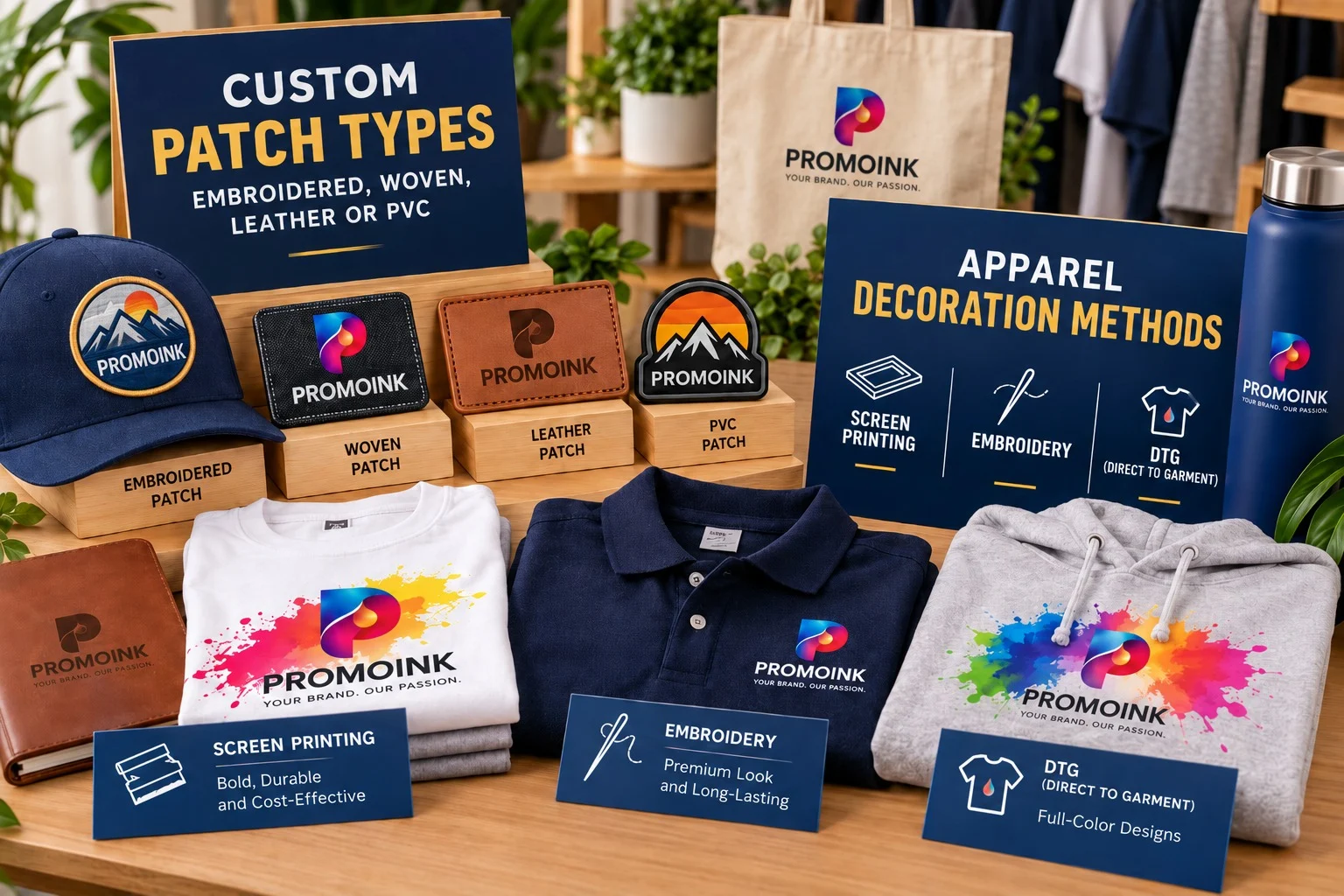
Screen printing usually suits larger orders with bold designs, embroidery works well on polos, hats, jackets, and other structured garments, while DTG is a strong choice for detailed artwork and smaller runs. PromoInk AI can help buyers compare these factors before selecting products and decoration methods for company apparel, events, teams, and promotional campaigns.
The Three Decoration Methods at a Glance
Screen printing, embroidery, and direct-to-garment printing all place branding on apparel, but the production process is different.
- Screen printing
- Embroidery
- DTG
- T-shirts, sweatshirts, large orders
- Polos, hats, jackets, workwear
- T-shirts, cotton apparel
- Bold graphics, simple to moderately detailed designs
- Logos, names, simple graphics
- Detailed, colorful artwork and photographs
- Medium to large
- Small to large
- Small to medium
- High with proper care
- Very high on suitable garments
- Good with proper care
- Cost per piece often drops as quantity increases
- Higher setup and stitching costs, especially for complex designs
- Higher per-piece cost for larger orders
Screen Printing: Practical for Larger Apparel Orders
Screen printing applies ink through a prepared mesh screen onto the garment. Each color generally requires its own screen, so the setup becomes more involved as the number of colors increases. The method is widely suited to cotton T-shirts, sweatshirts, tote bags, and similar fabric products. It can produce strong colors and a consistent appearance across larger quantities.
Choose screen printing when:
- You need dozens, hundreds, or more pieces.
- The artwork uses solid colors and defined shapes.
- Your design has a relatively simple color structure.
- You want a durable print for regular apparel use.
- Keeping the per-piece cost controlled matters.
Screen printing becomes particularly attractive as order volume rises because setup costs are spread across more garments. A 100-piece order can therefore have a much lower effective decoration cost per item than a very small order using the same setup.
For designs with many colors, gradients, photographic details, or very fine elements, the production process can become more involved. Modern screen-printing techniques can handle complex artwork, but the design still needs to be prepared correctly for the selected process.
Embroidery: A Strong Match for Structured Apparel
Embroidery creates the design with stitched thread rather than ink. The result has texture, dimension, and a more tactile appearance. It works especially well on garments that have enough structure to support stitching, including polo shirts, hats, jackets, fleece garments, uniforms, and some workwear.
Logo size matters- A small embroidered company logo can look polished on a polo, while a large design with excessive detail may not translate well into stitching.
Embroidery is a practical choice for:
Corporate polos
Small chest logos are a common application because the design remains visible without dominating the garment.
Caps and hats
Embroidery can give headwear a defined logo treatment that works well with simple brand marks.
Jackets and outerwear
Thread can provide a durable decoration for garments used repeatedly
Uniforms and workwear
Names, logos, and department identifiers can be stitched onto suitable fabrics.
Premium-looking branded apparel
The raised texture can create a more substantial visual effect than a flat print.
Embroidery pricing is often influenced by stitch count rather than simply the number of colors. A detailed logo can require thousands of stitches, increasing production time and cost.
DTG: Detailed Artwork Without Traditional Screen Setup
Direct-to-garment, or DTG, printing places ink directly onto the fabric using specialized digital printing equipment. Unlike traditional screen printing, the artwork does not need a separate screen for each color.
That makes DTG particularly useful for detailed artwork, gradients, illustrations, and designs containing many colors.
The method generally performs best on suitable cotton or cotton-rich garments prepared for DTG printing. Garment color, fabric composition, pretreatment, and printer settings all affect the final result.
DTG can make sense for:
- Small apparel orders
- One-off or personalized garments
- Full-color illustrations
- Photographic artwork
- Designs with gradients
- Designs containing many colors
The trade-off is cost. DTG can be efficient for short runs because there is less traditional setup, but screen printing may offer a lower per-piece cost as the order quantity increases.
DTG vs Screen Printing for Your Artwork
The DTG vs screen printing decision often comes down to artwork and quantity.
Consider a company ordering 200 black T-shirts with a two-color logo. Screen printing may be well suited because the design is relatively simple and the quantity allows setup costs to be distributed across many pieces.
Now consider a company ordering 20 shirts featuring a detailed full-color illustration. DTG may be more practical because the order is small and the artwork contains details that are not as straightforward for conventional screen printing.
Screen Printing vs. DTG
Small Quantities
- Screen Printing: Less cost-efficient in some cases due to setup requirements.
- DTG: Often well suited for smaller orders.
Large Quantities
- Screen Printing: Often highly cost-efficient for bulk orders.
- DTG: Can become more expensive per piece at higher quantities.
Solid Colors
- Screen Printing: Excellent for bold, solid-color designs.
- DTG: Good for solid colors, although this is not its main advantage.
Gradients
- Screen Printing: Possible, but requires more production planning and setup.
- DTG: Excellent for gradients and smooth color transitions.
Photographic Artwork
- Screen Printing: Possible with specialized printing techniques.
- DTG: A strong choice for detailed and photographic artwork.
Color Count
- Screen Printing: More colors can increase setup requirements and production costs.
- DTG: Can handle many colors digitally without separate screens.
Texture
- Screen Printing: Can produce a flat or slightly raised ink texture depending on the printing process.
- DTG: Generally produces a smoother print feel.
Best Garment Match
- Screen Printing: Works well for T-shirts, sweatshirts, and other fabric products.
- DTG: Best suited for cotton apparel and garments with a high cotton content.
Neither method should be selected from artwork alone. Fabric, garment color, order size, and intended use also matter.
How Order Quantity Changes the Cost
Quantity is one of the clearest cost factors in apparel decoration.
Screen printing usually involves preparation and setup before production begins. Those costs can be divided across the total number of garments. As the quantity increases, the average decoration cost per item often decreases.
Embroidery also involves setup and production considerations. Digitizing the artwork creates a stitch file, while the final price can depend heavily on stitch count, garment type, and quantity.
DTG generally has less traditional setup compared with screen printing, making it useful for smaller orders. However, each garment still requires individual printing and curing or finishing steps.
For first-time swag buyers, compare the total project cost, not just the advertised decoration price. Include:
- Garment cost
- Decoration cost
- Artwork preparation
- Setup or digitizing charges
- Number of print locations
- Shipping
- Rush production fees
- Reprint or replacement considerations
A lower decoration price does not always produce the lower total order cost.
Artwork Complexity Can Change the Decision
Artwork should be evaluated before choosing the decoration method.
Simple logo with one to three solid colors
Screen printing is often a natural fit for T-shirts and sweatshirts, especially for larger quantities.
Small logo with text
Embroidery can work well on polos, caps, jackets, and uniforms. Fine lettering should be checked at the intended physical size before production.
Detailed illustration
DTG may preserve small color variations and visual details more easily on appropriate garments.
Large photographic design
DTG can reproduce photographic imagery without building traditional screens for each color. Screen printing can also reproduce detailed imagery through specialized techniques, but the production process may be more involved.
A production-ready file should be checked for resolution, dimensions, color requirements, and placement before the order is approved.
Garment Type Should Guide the Method
The same logo can look completely different depending on the garment.
- T-shirts: Screen printing is a common choice for larger runs. DTG can suit smaller quantities and detailed artwork.
- Polos: Embroidery is often appropriate for company logos because the fabric and garment structure support stitching.
- Hats: Embroidery is frequently suitable, particularly for simple logos with readable shapes.
- Hoodies and sweatshirts: Screen printing works well for bold front or back graphics. Embroidery can also work for smaller chest logos.
- Jackets: Embroidery is useful for many structured outerwear garments, although fabric thickness and construction should be checked first.
- Performance apparel: Decoration requirements vary by fabric. Synthetic materials may require specific inks or decoration processes, so the garment and decoration method should be evaluated together.
Which Method Offers Better Durability?
The question of embroidery vs printing durability does not have one universal answer.
Embroidery can be highly durable because the decoration consists of thread stitched into the garment. It is particularly suitable for garments that receive repeated use, provided the fabric can support the stitching.
Screen printing can also provide strong durability when quality inks, appropriate curing, suitable garments, and proper care instructions are used.
DTG prints can last through repeated washing, but the result depends on garment composition, pretreatment, ink application, curing, and laundering practices.
For all three methods, care instructions matter. Excessive heat, harsh detergents, aggressive washing, and improper drying can reduce the life of decorated apparel.
A Simple Decision Framework for First-Time Buyers
Use this five-step process before placing an order.
Decide first whether you need T-shirts, polos, hats, jackets, sweatshirts, or another product.
Check the number of colors, level of detail, text size, gradients, and overall dimensions.
Small orders can favor digital printing, while larger orders can make screen printing more cost-efficient. Embroidery can work across different quantities, with stitch count affecting pricing.
Event shirts used for a single campaign have different requirements from uniforms worn every week.
Review decoration, garments, setup, shipping, production timing, and any additional charges before choosing. This process gives HR teams and marketing managers a clearer basis for comparing quotes from apparel suppliers.
Common Mistakes to Avoid
- Choosing embroidery for artwork with too much fine detail.
- Selecting screen printing without considering setup costs for a small order.
- Using DTG on a garment that is not well suited to the process.
- Making embroidered text too small to remain readable.
- Comparing suppliers using decoration price alone.
- Approving artwork without checking the final physical size.
- Ignoring garment fabric and color.
- Ordering a large quantity before reviewing a production sample or proof when available.
- A few minutes spent reviewing these details can prevent costly production problems.
How PromoInk AI Fits Into the Buying Process
PromoInk AI gives businesses a place to consider apparel and promotional product choices alongside practical order requirements. For a first-time buyer, the useful starting point is not simply selecting a decoration style. It is matching the garment, artwork, quantity, intended use, and budget.
For larger branded apparel programs, review production timelines carefully and confirm artwork specifications before approving the order. PromoInk AI also offers free standard delivery on qualifying US orders, 24-hour rush production availability, and reviews every order before it ships.
Frequently Asked Questions
Is screen printing cheaper than embroidery?
For larger quantities of T-shirts with relatively simple artwork, screen printing can offer a lower per-piece decoration cost. Embroidery pricing depends on stitch count, garment type, and quantity, so the total quote should be compared rather than judging by method alone.
Is DTG better than screen printing for small orders?
DTG can be a practical option for small orders because it does not require traditional screen preparation for each color. Screen printing may become more cost-efficient as the quantity increases.
Which decoration method lasts the longest?
Durability depends on the decoration process, garment, production quality, and care. Embroidery can be highly durable on suitable garments, while properly produced screen printing can also withstand repeated use. DTG durability varies with fabric, pretreatment, curing, ink application, and washing.
Can you embroider a detailed logo?
Highly detailed logos can be difficult to reproduce clearly at small sizes because thread has physical limits. Simplifying tiny details or increasing the logo size can improve the final result.
Is DTG good for company shirts?
DTG can work well for company shirts that use detailed, full-color artwork, especially for smaller orders. The garment should be compatible with the DTG process.
Which method is best for custom apparel?
The best decoration method for custom apparel depends on the garment, quantity, artwork, budget, and expected use. Screen printing often suits larger runs and bold graphics, embroidery fits structured garments and smaller logos, while DTG is useful for detailed full-color designs and shorter runs.
Making the Choice
Custom apparel works best when decoration and garment selection are treated as one decision. A bold two-color design printed on hundreds of T-shirts has different production requirements from a small embroidered logo on company polos or a detailed illustration printed on a limited number of shirts.
Screen printing, embroidery, and DTG each have clear strengths. Compare the artwork, fabric, quantity, durability expectations, production timeline, and complete cost before approving the order. That evaluation gives your team a practical way to choose decoration that fits the actual purpose of the apparel rather than simply selecting a method based on appearance or price alone.
Need help choosing the right decoration method for your branded apparel order? Contact us with your garment type, artwork, quantity, and deadline. Our team can help you evaluate the available options and select an approach that fits your project requirements. Ask about available apparel products, standard delivery, and 24-hour rush production for qualifying orders.