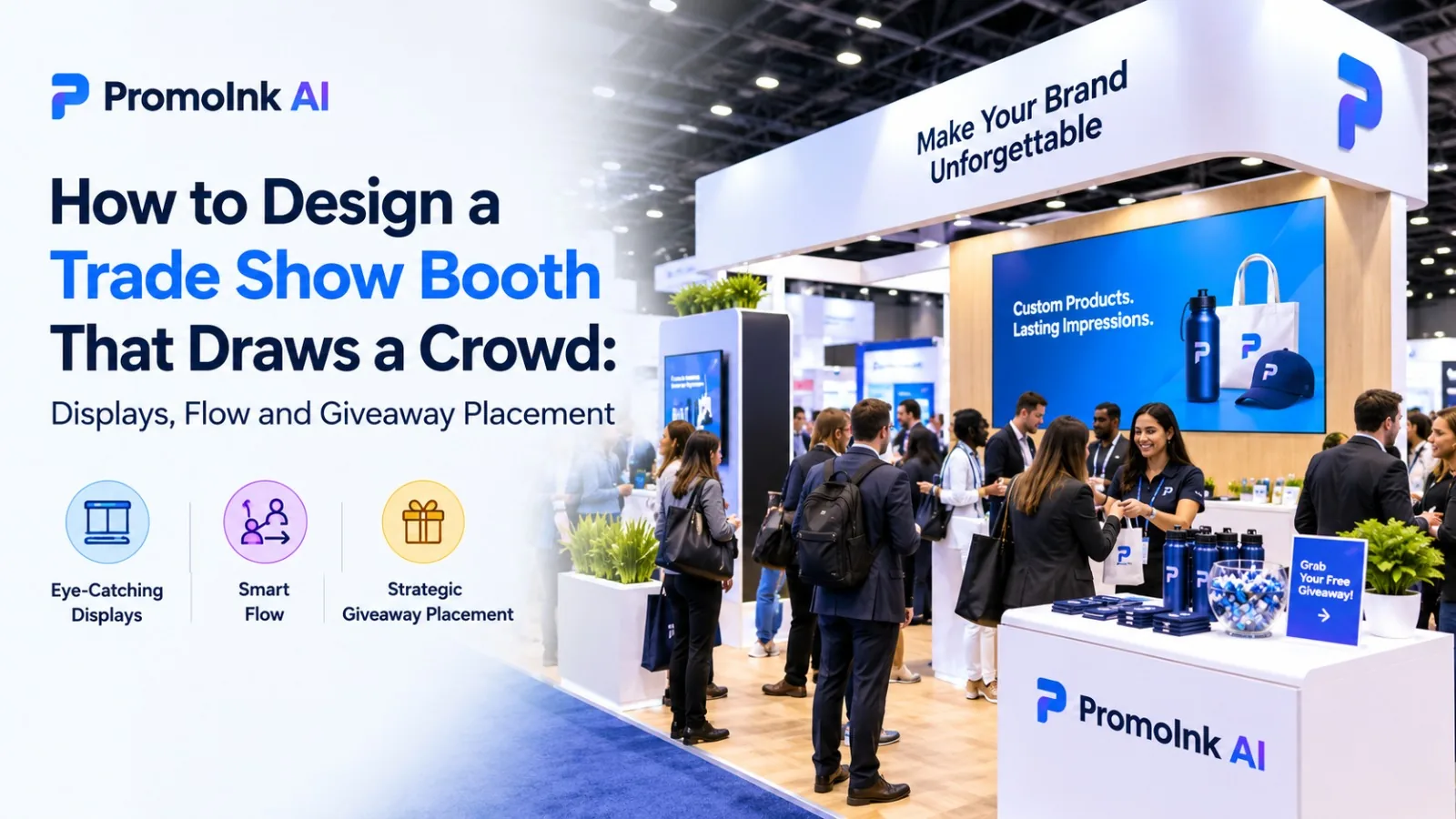
A successful trade show booth gives people a reason to stop, makes it easy to understand what you offer, and guides visitors naturally toward a conversation. Learning how to design a trade show booth starts with three practical decisions: create a visible display, plan booth traffic flow, and place giveaways where they support engagement instead of creating a bottleneck.
PromoInk AI offers branded displays and signage, trade show merchandise, curated trade show collections, and product recommendations that can help event teams coordinate booth visuals and giveaways around the same campaign.
Start With One Clear Booth Goal
A booth can support several marketing activities, but visitors should understand the main message within a few seconds. Decide what the booth needs to accomplish before selecting displays, graphics, furniture, or promotional products.
Common objectives include:
- Generating qualified leads
- Demonstrating a product or service
- Scheduling sales meetings
- Building brand awareness
- Introducing a new product
- Collecting contact information
- Distributing useful branded merchandise
A booth designed around lead generation may need an open conversation area and a simple lead capture station. A product demonstration booth may require more floor space and stronger sightlines toward the demonstration area.
The objective determines the layout. Without that decision, booths often become crowded collections of banners, tables, samples, screens, and giveaways with no clear visitor journey.
Build the Layout Around Visitor Movement
A good booth layout starts with movement. People walking through an exhibition hall should be able to see where they can enter, where they can stand, and where they can speak with your team.
Avoid placing large tables or display cases directly across the front of the booth. They can create a physical barrier between staff and attendees.
A more inviting layout usually includes:
Open entry points
Leave enough space for visitors to step inside without feeling that they are entering a restricted area.
Visible messaging
Place your primary message high enough to remain readable above normal foot traffic, within the show's height and sightline rules.
Defined zones
Separate product demonstrations, conversations, displays, and giveaway areas.
Clear exits
Visitors should be able to leave without squeezing past furniture or other attendees.
Staff space
Give booth representatives enough room to move and interact without blocking visitors.
Think of the booth as a small room without walls. Every object occupies valuable space, so each piece should have a clear purpose.
Create a Visual Hierarchy From the Aisle
Your booth competes with dozens or hundreds of nearby displays. A visitor first sees the overall structure, then the main message, and only afterward the supporting details.
A useful visual hierarchy can follow this order:
Brand → Main message → Supporting visual → Action
For example, a booth might feature a prominent company name and logo at the top, a short statement explaining the offer beneath it, a product image or demonstration area in the center, and a simple invitation to speak with the team.
Avoid covering every available surface with text. Large type, strong contrast, and generous spacing usually communicate faster than paragraphs printed on banners.
Your primary message should answer a simple question: Why should someone stop here?
Use Displays That Work From a Distance
Displays should perform different jobs rather than repeat the same information.
A strong booth may combine:
- Backwall graphics for brand recognition
- Retractable banners for secondary messages
- Product displays for demonstrations
- Counter graphics for close-range information
- Digital screens for video or presentations
- Hanging signs for large venue visibility (where show rules and booth type allow them)
- Branded table covers for a clean, professional front counter
- Literature holders for detailed information
Explore displays and signage to compare options for different booth sizes and purposes. Retractable banners can communicate supporting messages, while branded table covers help create a consistent, professional appearance at front counters and registration areas.
Large graphics are particularly useful for communicating from the aisle. Smaller printed materials work better after someone has already entered the booth.
For a cohesive appearance, repeat a limited set of brand elements such as logo treatment, typography, imagery, and messaging. Consistency helps visitors recognize that every part of the booth belongs to the same company.
Make the Backdrop Work Harder
A backdrop often becomes the visual anchor of a booth. It should not simply display a large logo.
Useful step and repeat backdrop ideas include repeating a logo pattern for photo opportunities, creating a branded interview area, or using a repeated graphic treatment behind a product demonstration.
Step and repeat designs work especially well when attendees may take photographs inside the booth. They can place the brand naturally in the background without requiring visitors to hold a promotional item for the logo to appear.
For a stronger backdrop, consider:
- Keeping the logo pattern large enough to appear clearly in photos
- Leaving enough visual space between repeated marks
- Positioning the backdrop behind the main conversation or photo area
- Matching the backdrop with other booth graphics
- Avoiding excessive text that becomes difficult to read in photographs
The backdrop should support the booth experience rather than compete with the people and products in front of it.
Plan the Visitor Journey Before the Event
After the physical layout is set, map the sequence you want a visitor to follow.
A simple path might be:
Aisle → Attention point → Main message or demonstration → Staff conversation → Lead capture → Giveaway → Exit
The sequence should match the booth goal. A demonstration-focused booth may move visitors toward the product first, while a lead-generation booth may prioritize a quick qualification conversation before the giveaway.
Test the path before the event by asking where visitors are likely to stop, where queues could form, and whether one activity blocks access to another.
Place Giveaways Where They Support Engagement
Promotional products can attract visitors, but giveaway placement requires some planning. Putting every item at the front of the booth may encourage people to grab a product and leave before interacting with the team.
A better approach is to connect the giveaway to the visitor journey.
Placing giveaways at the booth entrance attracts attention from the aisle, but it can create crowding. A conversation area is ideal for reinforcing a completed interaction, although it requires staff coordination. At a product demonstration, giveaways connect merchandise with the product, but the booth needs enough counter space.
A lead capture station gives visitors a reason to complete a form, though it can create a queue. Placing giveaways near the exit leaves visitors with a branded reminder after their visit, but this placement is less effective for starting conversations.
For ideas that fit different audiences and event objectives.
Choose Giveaways That Match the Booth Experience
A giveaway should make sense for the audience and the event. Useful products are more likely to stay with recipients after the show.
Consider:
- The attendee's professional role
- The event theme
- The season and venue
- Travel convenience
- Product usefulness
- Branding space
- Quantity required
- Distribution method
For example, compact items can work well for attendees carrying conference materials throughout the day. Larger products may be better suited to visitors who have a practical way to transport them.
The product should also complement the booth message. A company promoting workplace technology might use desk accessories. An outdoor-focused brand might choose products suited to travel or activity.
The goal is not to give away the most items. It is to make the promotional product part of the interaction.
Give Staff a Defined Role in the Layout
Even a well-designed booth can feel difficult to approach if staff members cluster together or stand behind a counter.
Assign simple roles before the event:
Greeter
Welcomes visitors and identifies basic interests.
Product specialist
Handles detailed demonstrations or technical questions.
Conversation lead
Holds deeper discussions with qualified prospects.
Lead coordinator
Manages contact collection and follow-up details.
Staff positioning should leave sightlines open. Team members should be able to see visitors approaching without making the booth feel like a guarded reception desk.
Staff positioning should leave sightlines open. Team members should be able to see visitors approaching without making the booth feel like a guarded reception desk.
Design for Photos and Social Sharing
Trade show visitors frequently photograph booths, demonstrations, signage, and branded experiences. Design areas that look good in photographs without making the booth feel like a photo studio.
A branded backdrop can provide a natural photo point. A product demonstration can create another visual moment. Large, readable branding helps the company remain identifiable when photos are shared.
Keep important branding within the camera frame. If the logo sits too high, too low, or behind equipment, it may disappear from photographs.
A Practical Booth Planning Checklist
Before sending the booth design to production, review these areas.
- Is the company name easy to see?
- Can visitors understand the main offer quickly?
- Is the primary message short enough to read while walking?
- Are entry points open?
- Can visitors move comfortably through the space?
- Are conversation areas separated from high-traffic zones?
- Does each display serve a specific purpose?
- Are important graphics visible from the aisle?
- Does the backdrop support the brand experience?
- Do hanging signs and display heights comply with the show's rules?
- Are products placed where they will not block traffic?
- Does the giveaway fit the audience?
- Is there enough storage for additional inventory?
- Can team members move freely?
- Does everyone know their role?
- Is there a clear process for lead capture and follow-up?
- Are electrical, storage, shipping, and setup requirements accounted for?
- Are display dimensions compatible with the assigned booth space?
- Are printed graphics and promotional products ordered early enough for production and delivery?
Common Booth Design Mistakes to Avoid
Some booth problems are easy to prevent during the planning stage.
Too much information: Dense graphics can make an otherwise attractive booth difficult to understand.
Blocked entrances: Large furniture at the front can discourage visitors from stepping inside.
Poor giveaway placement: A giveaway table positioned in a narrow passage can create congestion.
No conversation zone: Staff may struggle to have meaningful discussions if every available space is dedicated to displays.
Inconsistent branding: Different colors, messages, and graphics can make separate booth elements look unrelated.
Ignoring storage: Boxes, packaging, personal items, and extra merchandise should have a designated place instead of sitting behind counters or beside displays.
Ignoring show regulations: Display heights, hanging signs, aisle clearance, electrical equipment, and other installation details may be subject to venue or organizer rules. Confirm these requirements before finalizing the design.
Frequently Asked Questions
How should a trade show booth be laid out?
A trade show booth should have an open entry, visible messaging, clear product or display zones, a dedicated conversation area, and a logical location for lead capture or giveaways. The layout should allow visitors to move without crossing through staff work areas or creating congestion.
Where should giveaways be placed in a trade show booth?
Giveaways can be placed near the entrance for high-volume distribution, near a conversation area to support engagement, or close to lead capture when the product is intended as an incentive. Avoid placing large giveaway displays where they block entry points or narrow walkways.
What makes a trade show booth attractive?
Clear branding, readable messaging, strong visuals, open access, organized product displays, and a comfortable visitor path all contribute to an attractive booth. The design should communicate the company's main offer quickly rather than filling the space with excessive information.
How much information should be on a trade show booth display?
The main booth graphics should contain only the information visitors need to understand the company and its primary offer. Detailed specifications, case studies, brochures, and technical information can be provided after visitors enter and begin a conversation.
How can I improve trade show booth traffic flow?
Keep entrances open, position large displays away from narrow paths, separate high-traffic giveaway areas from conversation zones, and create a clear route from the aisle through the booth. Staff positioning should also leave enough space for visitors to move comfortably.
Build a Booth That Gives Visitors a Reason to Stay
A crowd does not form around a booth simply because it contains more graphics, products, or promotional items. People stop when the booth communicates a clear reason to engage and gives them enough physical space to do so comfortably.
Start with the visitor journey, then select displays, graphics, furniture, and giveaways that support each stage. A strong booth makes the brand visible from the aisle, provides an easy path inside, creates room for conversation, and places promotional products where they add value instead of creating congestion.
For event teams planning displays and giveaways together, PromoInk AI offers trade show merchandise, branded display and signage options, curated event collections, and product specialists who can help compare products, quantities, decoration methods, budgets, and delivery requirements.
Share your event type, booth size, attendee count, budget, and delivery date to narrow the options that fit your campaign. A well-planned booth helps every square foot of your space support your event goals.