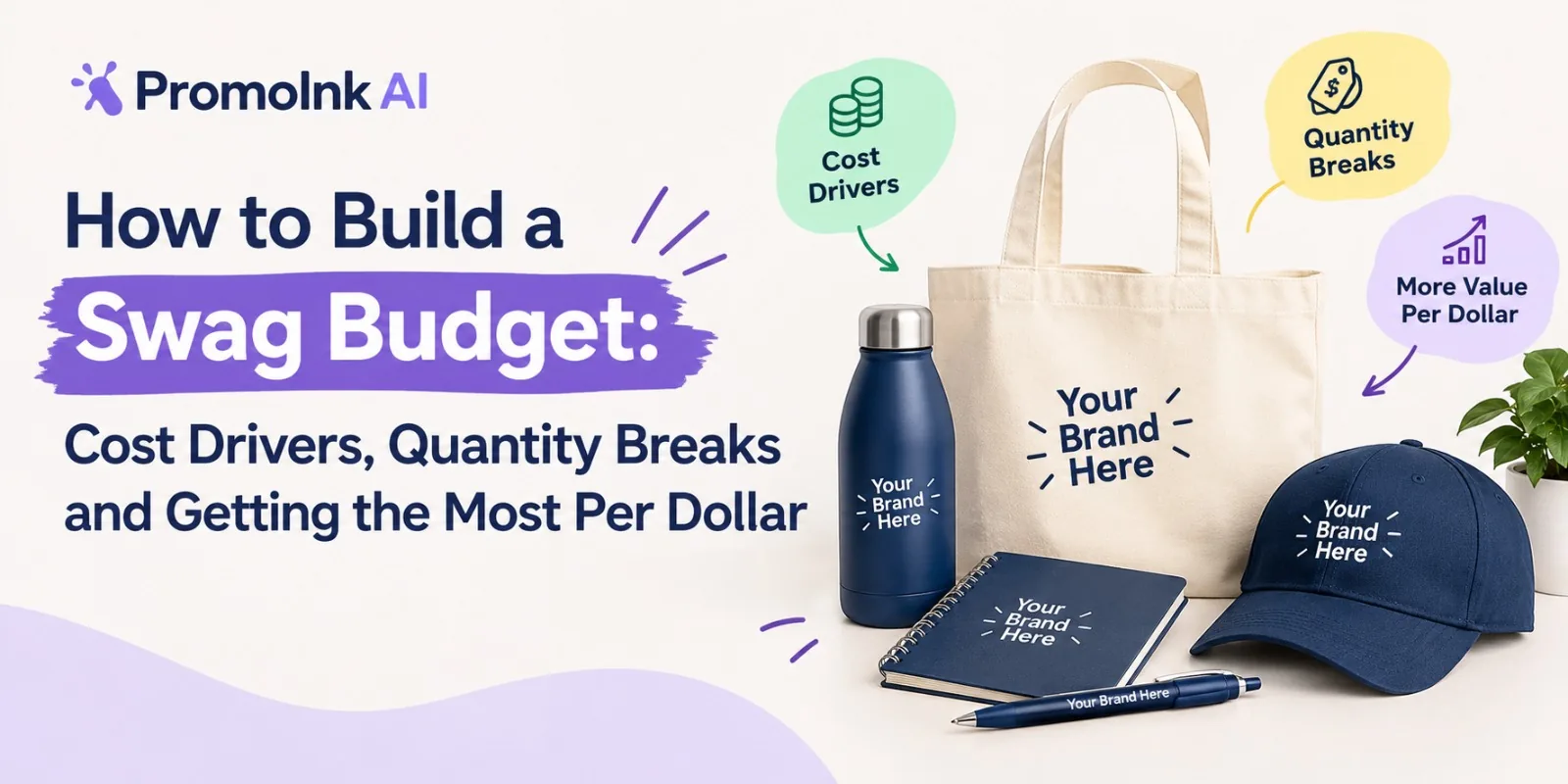
Start by identifying how many people you need to reach and how much you can spend per recipient. Then compare the complete delivered cost at different order quantities instead of selecting merchandise based only on the lowest unit price.
For example, a $5,000 campaign for 500 recipients provides an initial budget of $10 per recipient. However, if setup, decoration, packaging, and shipping are expected to consume $1,000, only $4,000, or $8 per recipient, remains available for the products themselves.
This guide explains how to calculate those costs, evaluate quantity breaks, compare product options, and estimate whether a promotional item is likely to provide enough useful exposure for the money spent.
Start With the Campaign Goal
A promotional product budget should begin with what the merchandise needs to accomplish. A trade show giveaway, employee welcome kit, customer gift, and community event can require very different spending levels.
Define four numbers before requesting product quotes:
- Total campaign budget: The maximum amount available for products, decoration, packaging, shipping, and other order-related costs.
- Recipient quantity: The number of people who should receive merchandise, plus a reasonable reserve for replacements or unexpected attendance.
- Non-product costs: Estimate setup charges, decoration, packaging, fulfillment, and shipping before deciding how much can be spent on the merchandise itself.
- Maximum product cost per recipient: Subtract estimated non-product expenses from the total budget, then divide the remaining amount by the number of recipients.
For example:
- Total budget: $5,000
- Estimated setup, decoration, packaging, and shipping: $1,000
- Product budget remaining: $4,000
- Recipients: 500
- Maximum average product cost: $8 per recipient
This calculation gives buyers a more realistic product budget than simply dividing the total campaign budget by the recipient count.
The Main Promotional Product Cost Factors
Unit price is only one part of the final cost. Several elements can change what a marketing team actually pays.
1. Product Type and Material
A basic cotton item may have a different starting price from a heavier garment, insulated drinkware, or a multi-component gift set. Material, construction, size, and features all influence the base product cost.
2. Quantity
Larger orders often receive lower per-unit pricing. Suppliers may offer price breaks at specific quantity thresholds, making the relationship between quantity and total spend important. Comparing promotional products with low minimum order quantities can also help businesses find options that fit smaller campaigns without committing to excess inventory.
3. Decoration Method
Screen printing, embroidery, laser engraving, pad printing, sublimation, digital printing, and other methods have different setup requirements and production costs. The artwork, number of imprint locations, and number of colors can also affect pricing.
4. Number of Decoration Locations
A logo on the front of a shirt may cost less than artwork printed on the front, back, and sleeve. For drinkware, adding multiple decoration areas can also increase production costs.
5. Artwork Preparation
Some orders require artwork adjustments, color matching, file preparation, or additional production work. Supplying clean, print-ready artwork can reduce avoidable production issues.
6. Packaging and Kitting
Individual packaging, gift boxes, inserts, assembly, and multi-item kits add labor and material costs. These expenses should be included before calculating the final campaign cost.
7. Shipping and Production Timing
Standard delivery, rush production, expedited shipping, and split shipments can affect the total invoice. A low unit price can lose its advantage if urgent delivery creates significant additional costs.
8. Supplier Pricing and Sourcing
Promotional product pricing is not always fixed throughout the year. Inventory availability, supplier price adjustments, sourcing location, freight conditions, and import costs can affect current pricing.
For that reason, use a current supplier quote when finalizing a campaign budget rather than relying on an older catalog price or a previous order.
If the campaign will run several months from now, include some flexibility in the budget and reconfirm pricing before production.
Quantity Price Breaks Explained
A quantity price break is the point at which a supplier's per-unit price drops because the order is larger.
Consider a hypothetical quote:
For an order of 100 units, the unit price is $8.50, bringing the total product cost to $850. For 250 units, the unit price decreases to $6.75, with a total product cost of $1,687.50. Ordering 500 units reduces the unit price to $5.40, resulting in a total cost of $2,700. For a larger order of 1,000 units, the unit price drops further to $4.65, bringing the total product cost to $4,650.
The 1,000-unit order has the lowest unit price, but it also requires the largest upfront spend. Buying more is not automatically the right financial decision.
Suppose your team only needs 500 items. Ordering 1,000 units at $4.65 costs $4,650, compared with $2,700 for 500 units at $5.40. The additional 500 pieces cost $1,950.
Before moving to the next quantity tier, calculate the incremental cost of the additional units.
In this example:
- 500 units = $2,700
- 1,000 units = $4,650
- Additional spend = $1,950
- Additional units = 500
- Effective cost of the extra units = $3.90 each
The decision should not be based only on the advertised $4.65 unit price for the 1,000-piece tier. Ask whether the business can realistically use the additional 500 items.
If those products would otherwise need to be reordered for another campaign, buying ahead may make financial sense. If they are event-specific, dated, seasonal, or likely to remain in storage, the lower unit price may not create a real saving.
Quick decision rule: Move to the next quantity tier only when the additional merchandise has a realistic planned use and the extra spend is justified by future demand.
Extra inventory may make sense if another event is scheduled, a sales team needs additional stock, or the products have a long useful life. It may make less sense for campaign-specific merchandise with a short promotional window.
Calculate Total Delivered Cost and Cost Per Recipient
A practical budget should account for expenses beyond the product itself.
Use this formula:
Total campaign cost = products + decoration + setup + packaging + shipping + other applicable fees
Then:
Cost per recipient = total campaign cost ÷ number of recipients
For example:
- 500 products at $5.40 = $2,700
- Decoration and setup = $350
- Packaging = $150
- Shipping = $300
- Total = $3,500
- Recipients = 500
- Cost per recipient = $7.00
The $7 figure is the campaign's approximate delivered cost per recipient because it includes the product and the main production and fulfillment expenses required to complete the order.
This distinction becomes especially important when comparing two suppliers.
For example:
- Supplier A product price: $5.00
- Supplier B product price: $5.40
Supplier A may appear less expensive initially. However, if Supplier A has higher setup, packaging, or freight charges, Supplier B could still have the lower delivered cost.
Compare suppliers using the same cost basis:
Delivered cost per unit = total order cost ÷ quantity received
This prevents a low advertised unit price from hiding higher costs elsewhere in the order.
Estimate Promotional Product Cost Per Impression
Cost per impression can help marketers compare promotional products that have different purchase prices and useful lives.
The basic formula is:
Estimated cost per impression = total campaign cost ÷ estimated lifetime impressions
The calculation itself is simple. Estimating impressions accurately is more difficult.
Consider:
- How often recipients are likely to use the product
- How long they are likely to keep it
- Whether it is normally used in public or private
- How visible the branding is during use
- Whether one product may be seen by several people
Industry research from the Advertising Specialty Institute (ASI) has found that frequently worn items such as T-shirts and outerwear can generate thousands of impressions over their useful life.
These findings demonstrate why durability and repeated use can materially affect promotional-product economics.
However, industry averages should not be treated as guaranteed results for an individual campaign. Actual impressions depend on the product, recipient behavior, geographic market, frequency of use, and length of ownership.
For budgeting purposes, cost per impression is most useful as a comparison metric between merchandise options rather than as a guaranteed advertising-performance figure.
Product Choice Can Change the Economics
Two products with similar unit prices can produce very different campaign value.
T-shirts and apparel costs depend on garment weight, material, size range, print colors, and imprint locations. Extra sizes and multiple imprint locations can increase the final average cost. Drinkware pricing varies by material, capacity, decoration method, packaging, and freight weight. Heavier drinkware may have a competitive unit price but higher shipping costs.
Tote bag costs depend on material, dimensions, imprint size, and handle construction. Simple designs can use economical decoration while retaining a large visible branding area. For tech accessories, compare compatibility, packaging, and product specifications, while prioritizing recipient relevance because unused products provide little marketing value.
Gift set budgets should account for individual products, boxes, inserts, assembly, and fulfillment, as kitting and shipping can represent a meaningful share of the total campaign cost. For event giveaways, consider quantity, portability, unit price, and delivery timing. High-volume promotional items under $1 can suit campaigns where distribution volume is a priority.
The lowest-priced product is not necessarily the lowest-cost campaign option. Compare product cost, decoration, fulfillment, shipping, expected use, and leftover inventory together.
Build a Tiered Swag Budget
A single product does not have to serve every audience. Segmenting the budget can help marketing teams allocate spending more deliberately.
A simple structure might include:
- High-volume items: Products intended for large events, conferences, or broad outreach.
- Mid-range merchandise: Items for prospects, customers, employees, or targeted campaigns.
- Higher-value gifts: Merchandise reserved for clients, partners, executives, or milestone occasions.
For example, consider a company with a $10,000 merchandise budget serving three different audiences:
Trade show attendees: $4,000
High-volume merchandise where portability, visibility, and distribution volume matter.
Customers and qualified prospects: $3,500
Mid-range products selected for stronger utility and repeated use.
Clients, partners, or milestone recipients: $2,500
Lower-volume merchandise where presentation and perceived value matter more than achieving the lowest unit cost.
These amounts (40%, 35% and 25% of the budget) are only an example; the right split depends on each campaign.
The advantage of tiering is that a business does not have to force a trade show attendee, long-term client, employee, and high-value prospect into the same cost-per-recipient target.
Allocate the budget according to the value and purpose of each recipient group.
Protect the Budget With a Pre-Order Checklist
Before approving an order, confirm the following:
- Final quantity
- Product specifications
- Decoration method
- Number of decoration locations
- Artwork requirements
- Setup or artwork fees
- Packaging requirements
- Shipping destination
- Required delivery date
- Rush production requirements
- Taxes or other applicable charges
- Expected leftover inventory
- Validity period of the supplier quote
- Sample or proof approval requirements
- Inventory availability
- Cost of shipping to multiple locations, if applicable
If the order includes multiple destinations, request both a consolidated shipping quote and a split-shipment quote. The difference can materially affect the final campaign cost.
Ways to Get More From the Same Promotional Product Budget
Reducing cost does not always require choosing a cheaper product. Several purchasing decisions can lower total campaign expenses without reducing the number of recipients.
Compare One Imprint Location With Multiple Locations
A second print, embroidery, or engraving location can increase decoration costs across every unit. Determine whether the additional branding materially improves the product before approving it.
Consolidate Repeat Orders Where Practical
If multiple departments or events will use the same merchandise and branding, combining demand may help the business qualify for a better quantity tier. Only consolidate when the additional products have a planned use.
Avoid Unnecessary Rush Production
Rush production and expedited freight can significantly change the delivered cost. When an event date is known in advance, work backward from the required delivery date and include time for artwork approval, production, and transit. Review PromoInk AI's 24-hour rush options when a campaign has a tight deadline, and confirm availability and delivery timing before placing the order.
Review Packaging Requirements
Individual boxes, inserts, tissue, labels, and assembly can improve presentation, but they also add material, labor, and shipping costs. Premium packaging may be justified for client gifts while being unnecessary for high-volume event merchandise.
Reuse Approved Artwork When Appropriate
Keeping approved logos, colors, and decoration specifications organized can reduce artwork corrections and speed up repeat orders.
Compare the Complete Delivered Price
When evaluating competing products or suppliers, compare product, decoration, setup, packaging, and freight together. A product with a lower unit price may not remain cheaper after these costs are added.
Promotional Product Budget Calculator
Use this framework when comparing an order.
Product cost
Quantity × unit product price
Production cost
Decoration + setup + artwork-related charges
Fulfillment cost
Packaging + kitting + shipping + applicable handling
Total campaign cost
Product cost + production cost + fulfillment cost
Cost per recipient
Total campaign cost ÷ number of recipients
Example
- Quantity: 500
- Product price: $5.40
- Product cost: $2,700
- Decoration and setup: $350
- Packaging: $150
- Shipping: $300
- Total campaign cost: $3,500
- Recipients: 500
- Cost per recipient: $7.00
If the campaign has a maximum budget of $4,000, this leaves a $500 contingency, equal to 12.5% of the available budget.
Keeping a contingency can be useful when final freight, taxes, artwork adjustments, or quantity changes have not yet been confirmed.
Record estimated and actual costs separately so the completed campaign can be used to improve future budget forecasts.
Common Promotional Product Budget Mistakes
The advertised product price may exclude decoration, setup, packaging, freight, and other costs. Always compare delivered campaign costs.
A lower unit price is not a saving when the additional inventory has no planned use.
Late ordering can introduce rush production or expedited shipping costs that could have been avoided with earlier planning.
A mass-event giveaway and an important client gift serve different purposes. Segmenting recipients can create a more rational spending plan.
Repeated use helps create exposure, but impressions are estimates. Product relevance, recipient fit, visibility, and usefulness should remain part of the decision.
Include expected remaining stock when evaluating campaign performance. High leftover inventory can indicate that the original quantity estimate was too aggressive.
Frequently Asked Questions
How much should a company budget for promotional products?
There is no single appropriate budget for every campaign. Start with the number of recipients, campaign objective, product category, decoration method, fulfillment requirements, and available marketing funds. Calculate the expected total cost before setting the final order quantity.
What affects the price of promotional products?
Major factors include product type, materials, quantity, decoration method, number of imprint locations, artwork requirements, packaging, shipping, and production timing. Quantity can also change the per-unit price through volume discounts.
Is it cheaper to order promotional products in bulk?
Bulk promotional product orders commonly have lower per-unit prices because suppliers may offer quantity-based pricing. However, the total amount spent increases as quantity increases. Compare the incremental cost of reaching the next price tier with the expected use of the additional inventory before increasing an order.
How do you calculate promotional product cost per impression?
Divide the total campaign cost by the estimated lifetime impressions generated by the merchandise. Estimating impressions requires assumptions about how often recipients use the product, how long they keep it, where it is used, and how visible the branding is. Industry benchmarks can help with comparison, but actual campaign impressions will vary.
Should shipping be included in a promotional product budget?
Yes. Shipping should be included when calculating the total campaign cost. Production timing, expedited delivery, packaging, and multiple delivery locations can also affect the final spend.
How do I know which promotional product quantity gives the best value?
Compare the total order cost at each quantity break, not only the unit price. Calculate how much additional money is required to reach the next tier and whether the extra merchandise has a planned use. A larger order usually provides better value only when the additional inventory is likely to be distributed or used in a future campaign.
Plan Your Swag Budget Before Requesting Quotes
Before selecting promotional products, document five things:
- Available campaign budget
- Number of recipients
- Required delivery date
- Decoration and packaging requirements
- Expected use of any leftover inventory
Then compare the complete delivered cost across appropriate products and quantity levels.
The best-value order is not necessarily the product with the lowest unit price. It is the option that meets the campaign objective at an acceptable total cost while providing merchandise recipients are likely to use.
PromoInk AI's Campaign Idea Advisor can help compare product options, quantities, decoration requirements, and fulfillment needs before production. Share your budget, quantity, delivery date, and intended audience to narrow the available options for your campaign.