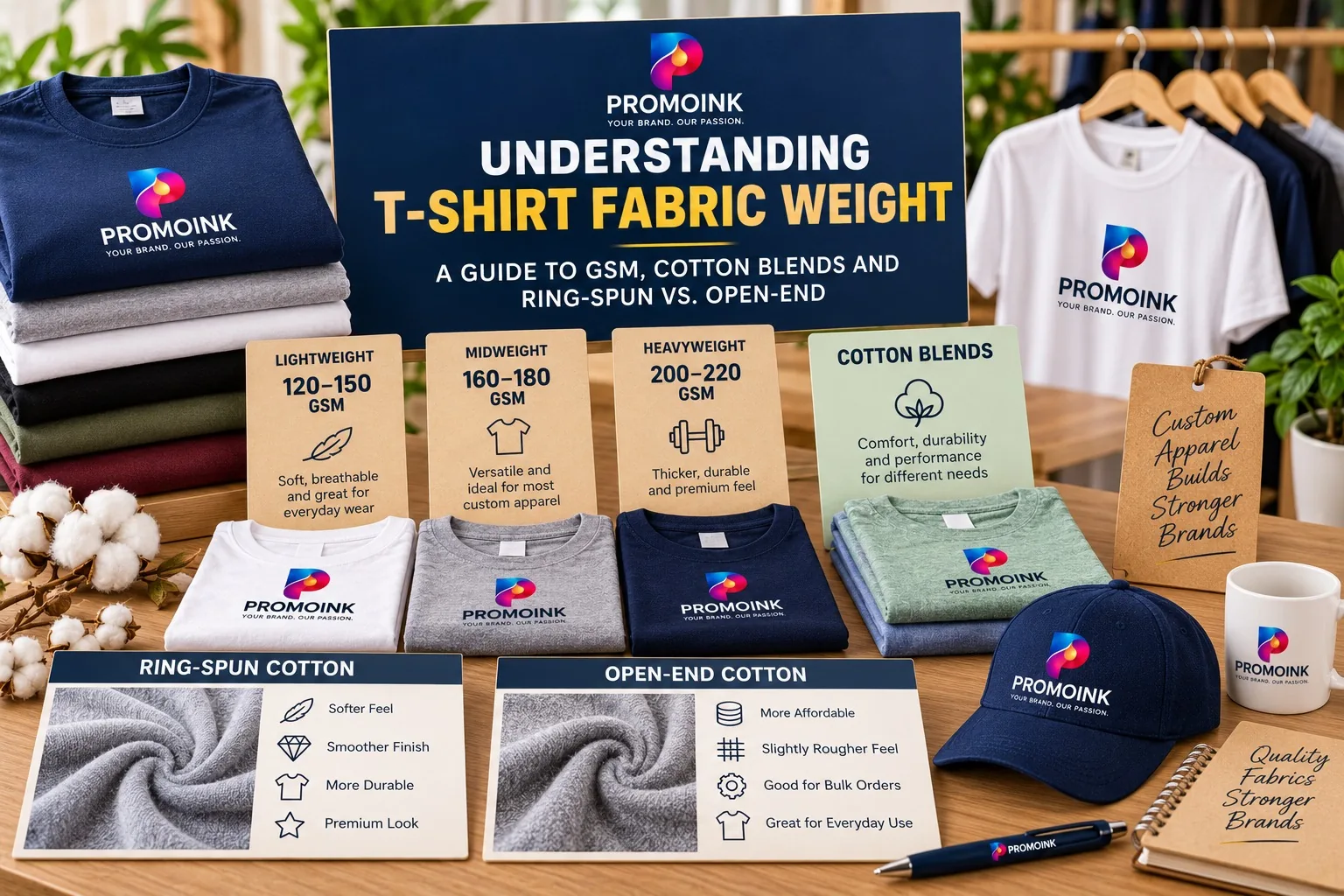
A lightweight shirt may suit hot weather and promotional events, while a heavier shirt can offer a structured fit and greater opacity. Cotton, polyester, ring-spun yarn, and open-end yarn each contribute different characteristics. This t-shirt fabric weight guide explains how to read garment specifications and compare quality before placing a custom apparel order. PromoInk AI can help buyers evaluate apparel options and select garments that suit their branding, comfort, and ordering requirements.
What Does T-Shirt Fabric Weight Mean?
T-shirt fabric weight describes how much a square meter of fabric weighs. Manufacturers typically express this measurement as GSM. A higher GSM generally indicates a heavier fabric, while a lower GSM indicates a lighter fabric.
For example, a T-shirt made from 180 GSM fabric weighs more per square meter than one made from 140 GSM fabric, assuming the measurements refer to comparable fabric types. This difference can affect the shirt's drape, opacity, warmth, durability, and overall appearance.
However, GSM is not a complete measure of quality. A lightweight ring-spun cotton shirt may feel softer than a heavier open-end cotton shirt. Similarly, a well-constructed polyester blend may withstand repeated washing better than a heavier shirt made from less suitable materials.
Buyers should evaluate fabric weight alongside fiber content, yarn construction, knitting quality, finishing, and intended use.
GSM Explained: How Fabric Weight Is Measured
GSM stands for grams per square meter. It measures the mass of fabric covering an area of one square meter. The calculation is straightforward:
GSM=Fabric weight in gramsFabric area in square meters\text{GSM}=\frac{\text{Fabric weight in grams}}{\text{Fabric area in square meters}}GSM=Fabric area in square metersFabric weight in grams
A fabric sample weighing 160 grams and measuring one square meter has a weight of 160 GSM.
Manufacturers may list a target GSM rather than an exact weight for every finished garment. Small variations can occur because of production tolerances, moisture content, finishing processes, and differences between fabric batches.
Common T-shirt GSM ranges
The following ranges are general buying references rather than fixed industry standards.
100 to 140 GSM
- Characteristics: Very light, airy, and comfortable in warmer conditions.
- Common Uses: Lightweight promotional T-shirts and summer apparel.
140 to 160 GSM
- Characteristics: Light, comfortable, and easy to wear or layer.
- Common Uses: Event T-shirts and everyday casual wear.
160 to 190 GSM
- Characteristics: Offers a balanced mix of weight, coverage, comfort, and structure.
- Common Uses: Branded T-shirts, uniforms, promotional apparel, and retail-style clothing.
190 to 220 GSM
- Characteristics: Heavier fabric with more structure and potentially better opacity.
- Common Uses: Premium casualwear and durable event or branded apparel.
Above 220 GSM
- Characteristics: Substantial, heavyweight fabric with a more noticeable drape and structured feel.
- Common Uses: Heavyweight fashion T-shirts and streetwear-inspired apparel.
These categories can overlap. A 180 GSM shirt made from combed cotton may feel quite different from a 180 GSM shirt made from a cotton-polyester blend.
Does higher GSM mean better quality?
Not automatically. Higher GSM means more fabric mass per unit area, not guaranteed softness, strength, or durability.
A high-GSM shirt may be unsuitable for outdoor summer activities because it can feel warmer. A low-GSM shirt may be the right choice for a large event where breathability and low cost matter more than structure.
Assess GSM according to the garment's purpose:
- Hot-weather events: Lightweight or medium-light fabrics may offer better comfort.
- Corporate uniforms: Medium-weight fabrics can balance coverage, durability, and ease of movement.
- Premium branded apparel: Medium-heavy or heavyweight fabrics may provide a more structured appearance.
- Layering: Lightweight shirts often work well under jackets, overshirts, or sweatshirts.
Why Fabric Weight Matters for Custom T-Shirt Buyers
Fabric weight influences more than the feel of a garment in your hand. It can affect how a printed design appears, how the shirt hangs on the body, and how comfortable it remains during extended wear.
1. Comfort and breathability
Lightweight fabrics generally allow easier airflow and may feel more comfortable in warm conditions. Heavier fabrics can provide a more substantial feel, but they may retain more warmth depending on their fiber content, knit structure, and finishing. Cotton is often valued for its soft hand feel and moisture absorption. Polyester can help with moisture movement and drying speed. The actual performance depends on the blend ratio and fabric construction.
2. Opacity and coverage
A heavier fabric often provides better coverage, but GSM alone cannot predict opacity. A loosely knitted 200 GSM shirt may show more through the fabric than a tightly knitted 160 GSM shirt. Color also matters. White and lighter-colored garments may require more attention to opacity, particularly for uniforms or apparel featuring large printed designs.
3. Shape and drape
Fabric weight influences how a T-shirt falls from the shoulders and around the torso. Lightweight fabrics often have a softer, more fluid drape. Heavier fabrics may create a straighter silhouette and feel more structured. Neither style is inherently better. The appropriate choice depends on the intended fit and the visual identity of the apparel.
4. Printing and embroidery
Fabric weight affects decoration indirectly. A heavier shirt may provide a stable surface for certain designs, but the decoration method, fabric smoothness, and garment construction matter just as much.
- Screen printing can work across a wide range of fabric weights when the ink and curing process suit the garment.
- DTG printing generally benefits from a smooth, compatible surface and suitable pretreatment.
- Embroidery requires enough fabric stability to support the stitched design without excessive puckering.
- Large, dense embroidery may feel uncomfortable on very lightweight T-shirts.
Before ordering, request a sample or decoration proof if the design has fine details, dense stitching, or extensive print coverage.
Cotton, Polyester, and Blended T-Shirts
Fiber content identifies the materials used to make the fabric. It is separate from GSM, which measures fabric mass.
Two T-shirts with the same weight can perform differently because their fibers absorb moisture differently, respond differently to heat, and have different levels of resistance to abrasion.
100% cotton
Cotton is a natural fiber valued for its soft feel, breathability, and moisture absorption. It is commonly used for everyday T-shirts, event apparel, and branded clothing.
- Comfortable hand feel in many fabric constructions.
- Good suitability for casual and promotional apparel.
- A wide range of available weights and finishes.
- Compatibility with several common decoration methods.
Limitations can include shrinkage, slower drying, and changes in shape after repeated washing if the fabric has not been properly treated or constructed. Cotton quality varies. Combed cotton, carded cotton, and different yarn types can produce noticeably different results.
Polyester
Polyester is a synthetic fiber often used in performance apparel and blended T-shirts. It is generally strong, dries relatively quickly, and can help garments retain their shape.
- Good resistance to many forms of wear.
- Faster drying than conventional absorbent cotton fabrics.
- Suitability for activewear and moisture-management designs.
- Reduced shrinkage compared with untreated cotton in many cases.
Polyester can retain odors in some conditions, and its feel varies according to yarn, knitting, and finishing. Dye migration can also affect certain printed designs, especially on dark polyester garments.
Cotton-polyester blends
A cotton-polyester blend combines two fibers to balance selected characteristics. Common ratios include 50% cotton and 50% polyester, as well as blends with a higher proportion of one fiber.
The term cotton vs. poly blend T-shirts refers to the difference between shirts made mainly from cotton and shirts made from a combination of cotton and polyester.
Hand Feel
- 100% Cotton: Often feels soft and natural, depending on the yarn and finishing process.
- Cotton-Polyester Blend: Can combine the softness of cotton with a smoother or more technical feel.
Moisture Behavior
- 100% Cotton: Absorbs moisture easily and may take longer to dry.
- Cotton-Polyester Blend: Often dries faster than a similar cotton fabric.
Shrinkage
- 100% Cotton: May shrink if the fabric is untreated or not properly pre-shrunk.
- Cotton-Polyester Blend: Often provides better shape and size stability after washing.
Heat Comfort
- 100% Cotton: Often comfortable in warm conditions, especially when the fabric is breathable.
- Cotton-Polyester Blend: Comfort depends on the blend ratio, fabric weight, and knit construction.
Durability
- 100% Cotton: Durability depends on the yarn quality, knit, fabric weight, and finishing.
- Cotton-Polyester Blend: The polyester content may improve resistance to stretching, wrinkles, and certain types of wear.
Decoration
- 100% Cotton: Works well with many printing and decoration methods.
- Cotton-Polyester Blend: Also supports many decoration methods, but requires attention to heat, dye migration, and fiber compatibility.
Typical Use
- 100% Cotton: Common for casualwear, events, branded basics, and everyday T-shirts.
- Cotton-Polyester Blend: Common for uniforms, activewear, workwear, and promotional apparel.
Fiber content does not determine the entire quality of a shirt. A well-made cotton T-shirt and a well-made blend can both be appropriate choices for different projects.
Ring-Spun vs. Open-End Cotton: What Buyers Should Know
Yarn construction is another specification that deserves attention. The terms ring-spun and open-end describe different methods of producing yarn from fibers.
These methods influence the yarn's feel, appearance, and certain performance characteristics. They do not directly indicate the GSM of the finished fabric.
What is ring-spun cotton?
Ring-spun yarn is produced by continuously twisting and thinning fibers using a ring-spinning process. The process can create a relatively fine, smooth yarn with a soft hand feel.
Ring-spun cotton is commonly associated with T-shirts marketed as soft, comfortable, or premium-feeling. Its characteristics can make it suitable for apparel worn close to the skin and for designs where a smoother fabric surface is desirable.
- A soft, comfortable hand feel.
- A relatively smooth yarn surface.
- Suitability for fine-gauge and lightweight fabrics.
- A refined appearance in many fabric constructions.
Ring-spun does not always mean combed. Combing is a separate process that removes a portion of shorter fibers and can further improve yarn uniformity.
What is open-end cotton?
Open-end yarn, also called rotor-spun yarn, is produced using a spinning method that forms yarn without the conventional ring-spinning process.
Open-end yarn is widely used in T-shirts and other textile products. It can offer efficient production and useful durability characteristics, although the feel depends on the fiber preparation, yarn count, and fabric construction.
- Efficient yarn production.
- A practical option for many everyday garments.
- A hand feel that may be less smooth than some ring-spun alternatives.
- Suitability for a variety of fabric weights and applications.
A buyer should not assume that every open-end shirt is rough or that every ring-spun shirt is exceptionally soft. The finished fabric depends on multiple manufacturing stages.
Ring-spun vs. open-end cotton comparison
Production Method
- Ring-Spun Yarn: Fibers are twisted together using a ring-spinning system.
- Open-End Yarn: Fibers are formed into yarn using a rotor-spinning process.
Typical Hand Feel
- Ring-Spun Yarn: Often feels smoother, softer, and more refined.
- Open-End Yarn: Can feel more substantial and slightly less smooth.
Yarn Appearance
- Ring-Spun Yarn: Often produces a finer and more uniform-looking yarn.
- Open-End Yarn: Appearance can vary depending on the yarn quality and fabric construction.
Typical Applications
- Ring-Spun Yarn: Commonly used for soft retail-style T-shirts and lightweight apparel.
- Open-End Yarn: Often used for everyday T-shirts, workwear, and promotional garments.
Quality Assessment
- Ring-Spun Yarn: Consider the yarn count, fabric construction, finishing, and overall feel.
- Open-End Yarn: Consider the yarn quality, fabric density, finishing, and overall feel.
GSM Relationship
- Ring-Spun Yarn: Can be used to produce both lightweight and heavyweight fabrics.
- Open-End Yarn: Can also be used in both lightweight and heavyweight fabrics.
The important distinction: Ring-spun yarn is not automatically stronger, and open-end yarn is not automatically inferior. Yarn count, fiber length, twist, knitting, and finishing all contribute to the finished result.
How Yarn Count and Knit Structure Affect Fabric Quality
GSM provides a useful weight measurement, but it does not explain every aspect of a T-shirt's construction.
Yarn count
Yarn count describes the fineness or thickness of the yarn. Different measurement systems are used for cotton and synthetic fibers, so buyers should check which system the manufacturer reports.
In many cotton specifications, a higher English cotton count indicates a finer yarn. A finer yarn can contribute to a smoother fabric, but the final result also depends on how the yarn is knitted and finished.
Knit structure
Most standard T-shirts use a knitted fabric, often single jersey. The loops in knitted fabric provide stretch and flexibility.
- Stretch and recovery.
- Surface smoothness.
- Thickness and coverage.
- Resistance to distortion.
- How the garment responds to washing
A 160 GSM single-jersey shirt may have a different feel and performance from a 160 GSM fabric made using another knit structure.
Pre-shrinking and finishing
Cotton can shrink during washing, particularly when it has not been properly treated. Pre-shrinking reduces the risk, but it does not guarantee that a garment will never change dimensions.
Finishing treatments can influence softness, smoothness, color appearance, and dimensional stability. Buyers should ask suppliers about pre-shrinking, wash-care instructions, and expected shrinkage.
A Practical Specification Checklist Before Ordering
A product listing that says only "premium cotton T-shirt" does not provide enough information to judge garment quality. Ask for measurable specifications and, where possible, inspect a sample.
- Fabric composition: Is the shirt 100% cotton, polyester, or a blend? What is the exact percentage?
- GSM: What is the stated fabric weight, and does it refer to the fabric or finished garment?
- Yarn type: Is the cotton ring-spun, open-end, combed, or another construction?
- Knit structure: Is the fabric single jersey, rib knit, or another type?
- Fit: Is the garment regular, relaxed, slim, or oversized?
- Shrinkage: Has the cotton been pre-shrunk? What dimensional changes should buyers expect?
- Colorfastness: How well does the garment retain its color after washing?
- Seam construction: Are the shoulder seams reinforced? Are the side seams straight and consistent?
- Decoration compatibility: Is the fabric suitable for screen printing, DTG, embroidery, or the selected method?
- Size consistency: Are measurements available for the actual garment style?
A supplier that provides clear answers to these questions makes it easier to compare products on specifications rather than marketing descriptions.
Matching Fabric Weight to Your Apparel Project
Different projects call for different garment characteristics. Use the following framework to narrow your options.
Consider lightweight to medium-light fabrics, breathable constructions, and comfortable fits. Check opacity and decoration performance before ordering.
Medium-weight T-shirts often provide a useful balance of comfort, coverage, and structure. A cotton-polyester blend may suit frequent use.
Medium-heavy or heavyweight garments may provide a structured appearance. Assess the yarn, fabric finish, fit, and decoration quality together.
Compare polyester content, drying performance, colorfastness, stretch, and resistance to repeated washing. GSM should be considered alongside these factors.
Common Fabric-Specification Mistakes
Even experienced apparel buyers can misjudge a shirt by focusing on only one specification.
A heavy shirt may feel substantial, but it may not suit a hot climate or a physically active event. Comfort and intended use should guide the decision.
Ring-spun yarn can provide a smooth hand feel, but poor knitting or finishing can still result in an unsatisfactory garment.
A shirt described as a cotton blend could contain very different ratios of cotton and polyester. Ask for the exact composition.
GSM comparisons are most useful when the fabrics have similar constructions and are being considered for the same purpose. Weight alone cannot establish which shirt is better.
A specification sheet cannot fully communicate softness, drape, color, seam quality, or the appearance of a printed logo. A physical sample provides valuable information before a large order.
Frequently Asked Questions
What is a good GSM for a T-shirt?
A GSM between approximately 160 and 190 is a practical starting range for many everyday and promotional T-shirts. Lighter fabrics may be more suitable for warm conditions, while heavier fabrics may provide more structure. The right choice depends on the fabric composition, knit, fit, and intended use.
Is a higher GSM T-shirt always better?
No. Higher GSM indicates greater fabric mass per square meter, but it does not guarantee softness, durability, or comfort. Fiber content, yarn construction, knit quality, finishing, and garment construction also affect quality.
What is the difference between ring-spun and open-end cotton?
Ring-spun cotton yarn is made using a ring-spinning process and is often associated with a smoother, softer feel. Open-end cotton yarn is made using rotor spinning and can be practical for everyday apparel. Neither method alone determines the quality of the finished T-shirt.
Is ring-spun cotton better for printing?
Ring-spun cotton often provides a smooth surface that can work well for printed designs. However, printing results also depend on the fabric finish, color, ink system, pretreatment, and production process. A suitable sample and print test are useful for detailed artwork.
Are cotton-polyester blend T-shirts durable?
Cotton-polyester blends can offer good durability and dimensional stability, depending on the blend ratio and construction. Polyester may improve resistance to certain forms of wear and reduce shrinkage, while cotton contributes a familiar natural hand feel. The specific fabric should be assessed rather than judged by the blend label alone.
What should I check before buying custom T-shirts in bulk?
Check the exact GSM, fiber composition, yarn type, knit structure, fit, shrinkage information, size chart, colorfastness, and decoration compatibility. Request a sample when possible, especially for large orders or detailed branding projects.
Making a Confident T-Shirt Buying Decision
A T-shirt specification becomes useful when each detail is connected to the way the garment will be worn. GSM helps buyers compare fabric weight. Fiber content explains the material composition. Ring-spun and open-end describe yarn production methods, while knit structure and finishing influence the final feel and performance.
For a successful custom apparel order, start with the project's climate, audience, budget, and intended use. Then compare fabric weight, yarn type, and fiber composition together. Ask for samples, review size measurements, and check decoration compatibility before approving a bulk order.
PromoInk AI can help you assess custom apparel specifications and choose garments that align with your branding and practical requirements. Talk to us about your T-shirt project, fabric preferences, and decoration needs so you can make an informed choice before ordering.