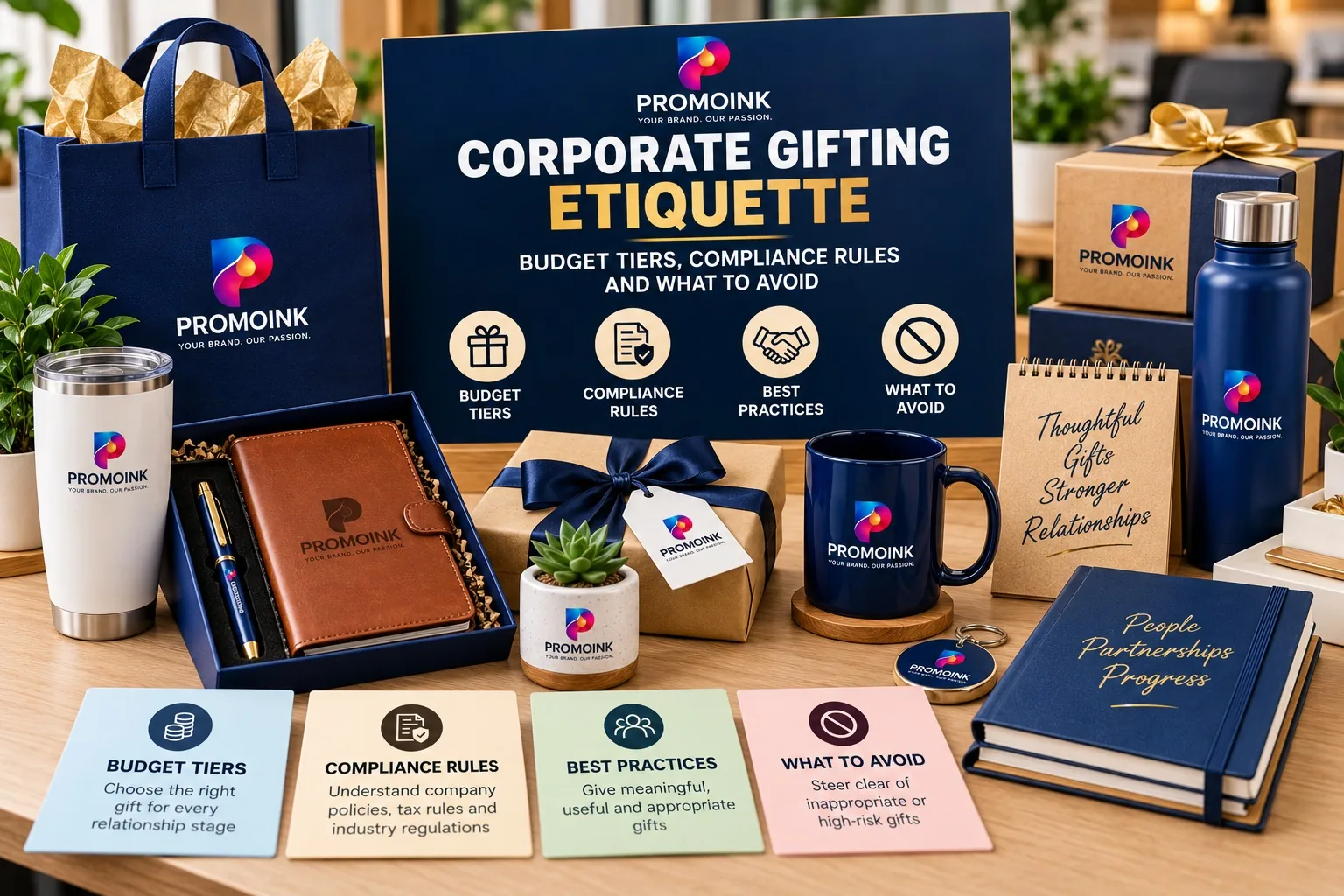
For most private-sector clients, there is no universal legal dollar limit on a business gift, but company policies, tax rules, industry regulations, and public-sector ethics rules can restrict what is acceptable. A practical budget can start around $15 to $25 for general client gifts, move toward $25 to $75 for established relationships, and go higher only when company policy and recipient rules allow it. PromoInk AI can help businesses select branded products that fit the occasion, audience, and planned spend.
Start With the Purpose of the Gift
A corporate gift should have a clear business purpose. Common reasons include thanking a client, recognizing a milestone, celebrating a successful project, welcoming a new customer, or showing appreciation after an event.
The purpose should also influence the value and style of the gift. A small branded notebook may be suitable for a large event, while a higher-value executive gift may make sense for a long-standing private-sector relationship.
Before placing an order, consider:
- Who will receive the gift?
- Why are you giving it?
- Is the recipient a private-sector employee, government employee, or public official?
- Does the recipient's employer have a gift policy?
- Is the gift connected to a contract, procurement decision, renewal, or negotiation?
- Does your company require internal approval?
- Can the gift be delivered without creating an awkward obligation?
These questions establish the basic etiquette framework before money is spent.
Corporate Gift Budget Per Person
There is no single corporate gift budget per person that works for every organization. The appropriate amount depends on your relationship with the recipient, company policy, event type, industry, and compliance requirements.
Practical Corporate Gift Budget Framework
A practical internal framework can help teams match gift value with the type of business relationship or occasion.
Everyday Appreciation
- Typical Planning Range: $10 to $25
- Common Use: Events, general client appreciation, and simple thank-you gifts.
Relationship Building
- Typical Planning Range: $25 to $75
- Common Use: Established clients, project milestones, and ongoing business relationships
Executive Recognition
- Typical Planning Range: $75 to $150+
- Common Use: Major milestones, high-value relationships, and senior-level recognition.
Public-Sector Recipients
- Typical Planning Range: Check applicable rules and policies before selecting a gift.
- Common Use: Government employees, public officials, and other regulated recipients
These ranges are planning guidelines, not legal limits. A company should always apply its own gift policy first.
For tax purposes, the IRS generally limits the deduction for business gifts to $25 per person per tax year. Certain incidental costs, such as packaging, shipping, or engraving, can be excluded from that calculation when they do not add substantial value. The IRS also identifies limited exceptions, including certain low-cost promotional items that cost $4 or less, carry the business name permanently, and are widely distributed.
The tax deduction limit should not be confused with a legal spending limit. A business could spend more than $25 on an eligible gift, but the amount above the applicable deduction limit may not receive the same tax treatment.
How Much to Spend on Client Gifts
The question of how much to spend on client gifts is best answered by considering the business relationship rather than the recipient's job title alone.
For broad client campaigns, a $10 to $25 range can keep costs controlled while allowing the company to send useful items to a large group. Examples include:
- Branded notebooks
- Pens
- Drinkware
- Tote bags
- Desk accessories
- Small tech accessories
For established clients, a $25 to $75 range can provide more room for useful, better-finished merchandise. Examples might include quality insulated drinkware, premium stationery, apparel, or curated gift sets.
Higher-value gifts require more care. A $100 gift may be reasonable in one private-sector setting and inappropriate in another. The recipient's employer could have a strict internal ceiling, or the gift could arrive during a procurement process and create an appearance issue.
The safest budget is therefore the highest amount permitted by the relevant policies, not simply the amount your marketing budget can support.
Gift Compliance Rules for Clients
Gift compliance rules for clients can vary significantly by industry and organization. A private company may allow client gifts up to a specific amount, while another organization may prohibit gifts entirely.
Before sending branded merchandise, check the recipient's:
- Employer gift policy: Many organizations establish their own limits and approval requirements.
- Industry requirements: Highly regulated industries may impose additional restrictions on gifts and entertainment.
- Procurement rules: Gifts sent during bidding, contract negotiations, or purchasing decisions may receive additional scrutiny.
- Government status: Government employees and public officials can be subject to specific ethics rules.
- Geographic requirements: Local and state rules can differ from federal requirements.
- Internal approval procedures: Your own organization may require compliance, legal, finance, or executive approval.
A useful rule for office managers and executive assistants is simple: check the recipient's policy before choosing the product, not after the order has been placed.
Public-Sector Gifts Require Extra Care
Government recipients require a different level of review.
For federal executive-branch employees, the general rule under 5 C.F.R. Part 2635 prohibits accepting gifts from prohibited sources or gifts given because of an employee's official position, subject to specific exceptions. One commonly cited exception allows unsolicited gifts valued at $20 or less per occasion, with a $50 annual limit from the same source. Cash and investment interests do not qualify for that exception.
The rule also involves more than the dollar amount. Federal ethics guidance advises employees to consider declining an otherwise permissible gift if acceptance could cause a reasonable person to question the employee's integrity or impartiality. Factors can include the gift's value, timing, the donor's interests, and the level of access associated with the gift.
State and local government employees can be subject to different rules. A gift acceptable under one government system may be prohibited under another.
For public-sector recipients, a branded pen or low-value promotional item may appear simple, but the recipient's agency policy still matters. Procurement officials, regulators, inspectors, and employees involved in awarding contracts deserve particular caution.
Foreign Officials and International Business
International corporate gifting adds another layer of compliance.
The U.S. Foreign Corrupt Practices Act can apply to gifts or anything else of value provided to foreign government officials when intended to obtain or retain business improperly. DOJ and SEC guidance states that nominal items, reasonable meals, and company promotional products are less likely to create enforcement concerns when there is no improper purpose, while larger or extravagant gifts can create greater risk.
That does not mean a low-value gift is automatically acceptable. The surrounding circumstances matter.
Avoid gifts that could be connected to:
- Winning or retaining a contract
- Influencing an official decision
- Receiving preferential treatment
- Expediting a government process
- Obtaining confidential information
- Changing the outcome of a regulatory matter
For international programs, businesses should have compliance personnel review gifts intended for government officials before distribution.
What to Avoid in Corporate Gifting
Good corporate gifting is not only about choosing the right product. It also means avoiding situations that can create discomfort, confusion, or compliance concerns.
Sending an expensive gift while negotiating a contract can create an appearance problem, even if the intention is simply appreciation.
Avoid gifts that may feel overly personal unless you have a well-established relationship and a clear reason for the choice.
Cash can create tax, compliance, and policy complications. Gift cards may also be restricted under certain organizational policies.
An expensive gift can send the wrong message when a modest, useful item would serve the same purpose.
Alcohol may conflict with workplace policies, personal preferences, cultural considerations, or recipient restrictions.
A single high-value gift to an individual can create an appearance issue. Team-oriented gifts may sometimes be more appropriate, depending on company policy.
A gift that breaks quickly or looks unfinished can undermine the intended message. Product quality should match the relationship and occasion.
A Simple Approval Process for Office Teams
Executive assistants and office managers often coordinate gifting on behalf of senior leaders. A short approval process can reduce mistakes.
- Step 1: Identify the recipient
- Record the person's company, role, location, and public-sector status if relevant.
- Step 2: Check the policy
- Review both your company's policy and the recipient organization's policy.
- Step 3: Confirm the purpose
- Document why the gift is being provided.
- Step 4: Set the per-person budget
- Include product, decoration, packaging, and other meaningful costs.
- Step 5: Review timing
- Avoid sensitive periods such as active procurement, contract negotiations, audits, or regulatory decisions.
- Step 6: Select the product
- Choose something useful, professional, and appropriate for the recipient.
- Step 7: Keep records
- Maintain the recipient, date, purpose, product, cost, and approval information.
The IRS states that businesses need records supporting the business purpose, description, amount, and date of business gifts.
Choosing Products That Fit the Budget
The product should match both the budget and the context.
Under $15
- Product Examples: Pens, notebooks, key accessories, and other simple branded items.
- Suitable For: Events, giveaways, and broad client outreach.
$15 to $25
- Product Examples: Tote bags, drinkware, stationery, and practical branded accessories.
- Suitable For: General client appreciation and routine business gifting.
$25 to $50
- Product Examples: Insulated tumblers, premium notebooks, apparel, and upgraded branded merchandise.
- Suitable For: Established clients, project milestones, and stronger business relationships.
$50 to $100+
- Product Examples: Executive gift sets, premium bags, higher-end drinkware, and other premium merchandise.
- Suitable For: Approved relationship milestones, executive recognition, and high-value client gifting.
The same product can also feel very different at different quality levels. A basic bottle may work for a large conference, while a well-finished insulated tumbler can be better suited to a smaller executive gift program.
PromoInk AI can support branded gifting programs with products across categories such as bags, beverageware, outdoor and sport items, and customized stationery. Product selection should still follow the recipient's policy and your organization's approval process.
A Corporate Gifting Checklist
- Business purpose is documented
- Recipient's organization is identified
- Recipient's gift policy has been checked
- Public-sector status has been reviewed
- Applicable industry rules have been considered
- Gift value falls within company policy
- Timing does not create a conflict concern
- Product is professional and appropriate
- Tax records can be maintained
- Internal approval has been completed
Frequently Asked Questions
What is a reasonable amount to spend on a corporate gift?
A practical planning range is often $10 to $25 for broad client gifting and $25 to $75 for established business relationships. Higher amounts should receive additional policy and compliance review. These are planning ranges, not universal legal limits.
Is there a $25 limit on business gifts?
The IRS generally limits the federal tax deduction for business gifts to $25 per person per tax year. This is a tax deduction rule, not a universal legal limit on what a business may spend.
Can you give gifts to government employees?
Government gift rules vary by jurisdiction and agency. Federal executive-branch employees are subject to specific ethics regulations, including restrictions on gifts from prohibited sources and gifts given because of official position. Some exceptions apply, including a limited-value exception.
Are promotional products considered business gifts?
Some promotional products may qualify for special tax treatment. The IRS provides an exception for certain items costing $4 or less that have the business name permanently imprinted and are widely distributed. Other promotional merchandise can be treated as business gifts depending on the circumstances.
Should companies give gifts during contract negotiations?
Extra caution is appropriate during contract negotiations, procurement decisions, audits, or regulatory matters. A gift can create an appearance of improper influence even when no improper intent exists. Checking the recipient's policy and obtaining internal approval before sending anything is a sound practice.
What information should companies record for client gifts?
Keep the recipient's name and organization, gift date, business purpose, product description, cost, and applicable approval records. These records can support internal compliance and tax documentation.
Building a Gift Program People Can Defend
Corporate gifts should feel thoughtful without creating unnecessary questions for the recipient or the company. A clear budget, documented purpose, policy review, and appropriate product selection provide a practical framework for most private-sector programs. Public-sector and international gifting require additional review because specific ethics and anti-corruption rules can apply.
The right gift is not necessarily the most expensive one. A useful branded item that fits the recipient's workplace and the occasion can communicate appreciation without creating an uncomfortable obligation. Teams planning a larger program can get in touch with PromoInk AI to discuss product options, branding requirements, and quantities before placing an order. Keeping the approval process simple and the documentation clear makes corporate gifting easier to manage year after year.